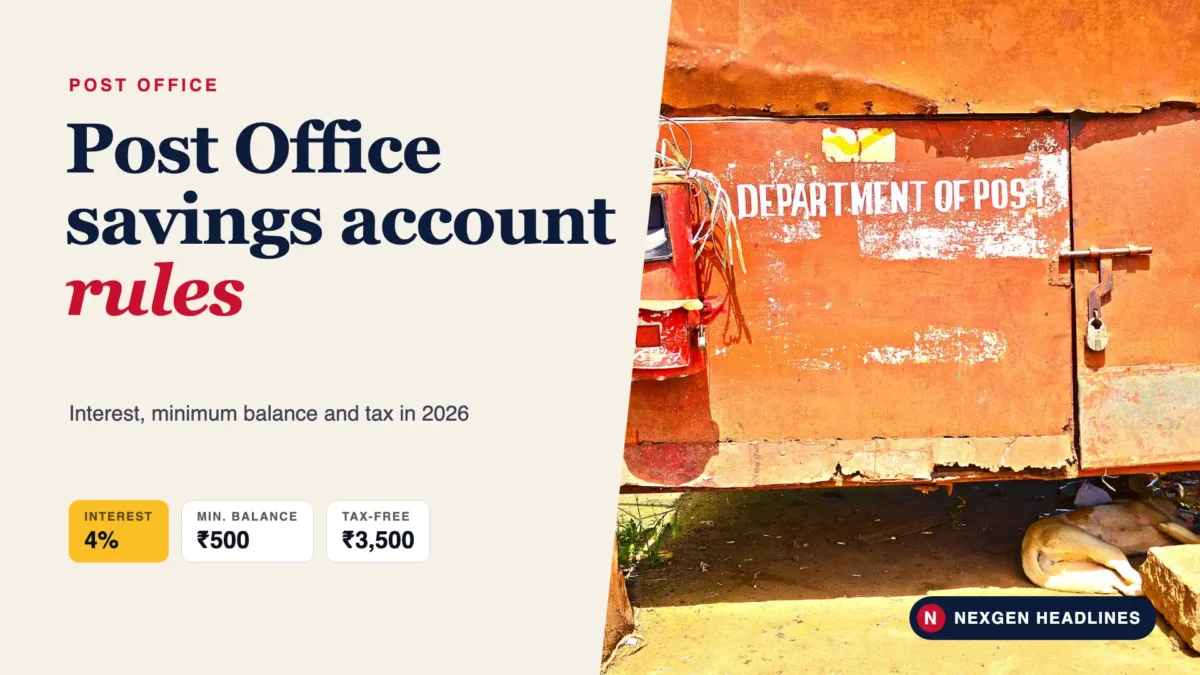
Quick answer: A Post Office Savings Account pays 4% interest a year (rate kept unchanged for October–December 2026). You need just ₹500 to open it and must keep at least ₹500 in it, or you earn no interest and a maintenance fee can be deducted. Interest up to ₹3,500 a year (₹7,000 for a joint account) is tax-exempt. Any Indian resident adult, a minor aged 10 or above, or a guardian for a minor can open one at any post office.
At a glance
- Interest rate: 4% a year (October–December 2026)
- Minimum to open: ₹500
- Minimum balance: ₹500
- Maximum deposit: no upper limit
- How interest is worked out: on the lowest balance between the 10th and the last day of each month
- Tax-free interest: up to ₹3,500 (single) or ₹7,000 (joint) a year
- Accounts allowed: one single account per person; joint account for up to 3 adults
- Facilities: cheque book, ATM card, net banking, mobile banking, IPPB linking
How to open a Post Office Savings Account: step by step
| Step | What to do | Tip |
|---|---|---|
| 1 | Visit any post office that offers savings bank service | Head and sub post offices offer it; most branch post offices do too |
| 2 | Ask for the account opening form (SB-3) and KYC form | Forms are also on the India Post website |
| 3 | Attach Aadhaar, PAN (or Form 60) and a photo | Aadhaar-based e-KYC can be done with a fingerprint at many post offices |
| 4 | Fill in nominee details | Always add a nominee; it saves your family trouble later |
| 5 | Deposit at least ₹500 in cash or by cheque | Keep the receipt |
| 6 | Collect your passbook and ask for an ATM card and cheque book | Cheque book needs a higher balance (ask your post office) |
Who can open a Post Office Savings Account
- A single adult (resident Indian)
- Two or three adults jointly, as Joint A (run by all) or Joint B (run by either or survivor)
- A guardian on behalf of a minor or a person of unsound mind
- A minor aged 10 or above, in their own name
An individual can hold only one single savings account at the Post Office. You can still be part of joint accounts. NRIs cannot open a new Post Office Savings Account.
Minimum balance rule: what happens below ₹500
This is the rule people miss most. You must keep at least ₹500 in the account at all times.
- If your balance stays below ₹500 during the 10th to month-end window, you earn no interest for that month.
- If the balance is below ₹500 at the end of a financial year and you don’t top it up, the Post Office can deduct an account maintenance fee. If the balance becomes nil, the account is closed automatically.
- Withdrawals that take the balance below ₹500 are not allowed.
Sources quote different fee amounts, so ask your post office for the current charge. The easy fix is to always keep a little more than ₹500.
How 4% interest is calculated
Interest is worked out every month on the lowest balance between the 10th and the last day of the month. It is added to your account at the end of the year.
That means timing matters. A deposit made on the 9th earns interest for that month. A deposit made on the 11th may not count until the next month.
Made-up example (for illustration):
Sunita keeps about ₹40,000 in her Post Office Savings Account all year. At 4%, she earns roughly ₹1,600 in interest for the year. Since this is under ₹3,500, the whole amount is tax-exempt.
Her neighbour Rakesh deposits his monthly salary on the 12th and spends most of it by the 9th of the next month. Because his lowest balance between the 10th and month-end is low, he earns much less interest than his average balance suggests.
These are made-up examples with round numbers. Actual interest depends on your daily balances.
Tax on Post Office Savings Account interest
Interest on a Post Office Savings Account is exempt up to ₹3,500 a year for a single account and ₹7,000 for a joint account. This was under Section 10(15)(i) of the old Income Tax Act. Tax experts report the same exemption is kept in the new Income-tax Act, 2025, which applies from 1 April 2026.
Interest above these limits is added to your income and taxed at your slab rate. You may be able to claim a further savings-interest deduction under the old tax regime. Rules differ under the new regime, so check with a tax professional before filing.
No TDS is deducted on Post Office savings interest, but you must still report it in your ITR.
Also read: Post Office RD interest rate 2026
Post Office Savings Account vs bank savings account
| Feature | Post Office SB | Typical bank savings account |
|---|---|---|
| Interest rate | 4% (set by government each quarter) | Often 2.5%–3% at big banks; varies |
| Minimum balance | ₹500 | ₹0 to ₹10,000 depending on bank and branch |
| Safety | Backed by Government of India | Deposit insurance up to ₹5 lakh per bank (DICGC) |
| Digital services | Net and mobile banking; IPPB app | Usually more advanced apps and UPI |
| Branch reach | Over 1.5 lakh post offices, many in villages | Fewer branches in rural areas |
Bank rates change often, so compare the current rate at your bank before deciding.
Withdrawals, transfers and other rules
- Withdrawals: by withdrawal form or cheque at the post office, or by ATM card. Minimum withdrawal at the counter is ₹50.
- Transfer: you can move the account from one post office to another anywhere in India.
- Silent account: if there is no deposit or withdrawal for three full financial years, the account is treated as silent (dormant). You need to submit a fresh KYC and an application to make it active again.
- Linking: link your POSB to an India Post Payments Bank (IPPB) account to use UPI and move money easily.
- Auto-credit: interest and maturity amounts of Post Office MIS, TD, RD and SCSS can be credited to your savings account.
Why a POSB is useful even if you have a bank account
Many people open a Post Office Savings Account only because other Post Office schemes need it. Monthly income from POMIS and SCSS is paid into this account. RD instalments can be auto-debited from it.
It is also handy for older family members in small towns where a post office is closer than a bank branch.
Common mistakes to avoid
- Letting the balance fall below ₹500. You lose interest and may pay a fee.
- Depositing after the 10th when you could deposit earlier.
- Not adding a nominee. Claims without a nominee take much longer.
- Ignoring the account for years. A silent account needs extra paperwork to revive.
- Forgetting to report interest above the tax-free limit in your ITR.
How to close the account
Visit your post office with the passbook and a closure form (SB-7B). The balance with interest is paid out in cash or to another account. Closing is free, but it cannot be done by a third party without proper authority.
Opening an account for your child
A parent or guardian can open an account in a minor’s name at any age. Once the child turns 10, they can open and run their own account. When the child turns 18, they must submit fresh KYC and an application to convert it into an adult account in their own name. Until then, the guardian signs for withdrawals on a guardian-run account.
It is a simple way to teach children saving, with a low ₹500 minimum and a passbook they can see.
Documents you need: quick checklist
- Aadhaar card (or Aadhaar number for e-KYC)
- PAN card, or Form 60 if you don’t have PAN
- One recent passport-size photo
- Nominee’s name, age and relationship
- For a minor’s account: the child’s birth certificate and the guardian’s KYC
FAQ
What is the Post Office Savings Account interest rate in 2026?
4% a year. The government kept it unchanged for the October–December 2026 quarter.
What is the minimum balance in a Post Office Savings Account?
₹500. Below that, you earn no interest for the month and a maintenance fee can be deducted at year-end.
Can I open a Post Office Savings Account online?
New accounts are usually opened at a post office. You can then use net banking, mobile banking and the IPPB app online.
Is Post Office Savings Account interest taxable?
Interest up to ₹3,500 a year (₹7,000 for joint accounts) is exempt. Anything above that is taxed at your slab rate.
How many Post Office Savings Accounts can I have?
Only one single account per person, plus joint accounts.
Bottom line
A Post Office Savings Account is a safe, low-cost account paying 4%. Keep more than ₹500 in it, deposit before the 10th of the month, and add a nominee. It works best alongside other Post Office schemes like POMIS, RD and SCSS.
Last reviewed: 13 November 2026. Rates are reviewed by the government every quarter.
Sources: India Post: Post Office Saving Schemes, Department of Economic Affairs, Ministry of Finance, National Savings Institute, Business Standard.
Featured image credit: India Post office in Ooty. Photo: Subhashish Panigrahi / Wikimedia Commons, CC BY-SA 4.0; edited by Nexgen India