Quick answer: The Public Provident Fund (PPF) pays 7.1% a year for October to December 2026, unchanged from the last quarter. You can deposit ₹500 to ₹1.5 lakh a year for 15 years. Interest and maturity are tax-free, and deposits qualify for Section 80C under the old tax regime. Open it at a post office or a bank that offers PPF.
At a glance
- Interest rate: 7.1% a year (October–December 2026), compounded yearly
- Deposit: Minimum ₹500, maximum ₹1,50,000 in a financial year, in multiples of ₹50
- Tenure: 15 years, extendable in blocks of 5 years
- Tax: Deposits under 80C (old regime); interest and maturity tax-free
- Loan: From the 3rd to the 6th financial year
- Partial withdrawal: From the 7th financial year
- Who can open: Resident Indians, one account per person (plus one for a minor child as guardian)
How to open a PPF account: step by step
| Step | What to do |
|---|---|
| 1 | Choose a post office or a bank (SBI, PNB, ICICI, HDFC and many others offer PPF) |
| 2 | Fill the account opening form, or apply in net banking if your bank allows it |
| 3 | Give KYC: Aadhaar, PAN, a photo and address proof |
| 4 | Add a nominee |
| 5 | Make the first deposit of at least ₹500 |
| 6 | Collect the passbook or check the account in net banking |
What is PPF and why people still choose it
PPF is a government-backed savings scheme run under the National Small Savings Fund. The interest rate is set by the Ministry of Finance every quarter. For October to December 2026, it stayed at 7.1%, the same rate as the previous quarters.
People like PPF for three simple reasons:
- Safety: It is backed by the Government of India.
- Tax-free returns: Interest and the maturity amount are not taxed. This is often called EEE (exempt-exempt-exempt).
- Discipline: The 15-year lock-in stops you from spending long-term savings.
How much will PPF give you?
Interest is calculated monthly on the lowest balance between the 5th and the last day of the month, and added to the account once a year. So deposit before the 5th of the month to earn interest for that month.
| Yearly deposit | Total deposited in 15 years | Approx. maturity at 7.1% |
|---|---|---|
| ₹12,000 (₹1,000 a month) | ₹1,80,000 | About ₹3.25 lakh |
| ₹1,50,000 (maximum) | ₹22,50,000 | About ₹40.68 lakh |
Estimates assume 7.1% for all 15 years and a deposit at the start of each financial year. The real rate can change every quarter, so treat these as projections.
Made-up example
These are made-up examples to explain the maths. Priya Sharma, 30, a teacher in Jaipur, deposits ₹1.5 lakh in her PPF every April. By 45, at 7.1%, she would have about ₹40.68 lakh, all tax-free.
Her brother Amit can save only ₹1,000 a month. He deposits it before the 5th each month. In 15 years, he would have about ₹3.25 lakh. Small, but steady and tax-free.
Loan and partial withdrawal rules
Loan against PPF (years 3 to 6)
From the third to the sixth financial year, you can take a loan of up to 25% of the balance at the end of the second year before the year you apply. You repay it within 36 months. The loan interest is a small margin over the PPF rate.
Partial withdrawal (from year 7)
From the seventh financial year, you can withdraw once a year. The limit is generally 50% of the balance at the end of the fourth year before, or the previous year, whichever is lower. You don’t repay it.
Premature closure (after 5 years)
You can close a PPF early after five financial years only for specific reasons, such as a serious illness of you, your spouse or dependent children, or higher education. If you do, the interest for the whole period is cut by 1%.
What happens after 15 years?
At maturity, you have three options:
- Close the account and take the full amount, tax-free.
- Extend for 5 years with deposits. You must submit the extension form within one year of maturity.
- Extend for 5 years without deposits. The balance keeps earning interest, and you can withdraw once a year.
Extension can be repeated in 5-year blocks, which many people use as tax-free retirement savings.
PPF tax rules in simple words
- Old tax regime: Deposits up to ₹1.5 lakh count under Section 80C, along with EPF, ELSS, life insurance and others.
- New tax regime: No 80C deduction, but interest and maturity are still tax-free.
- Show PPF interest as exempt income in your ITR.
Common mistakes
- Missing the yearly ₹500. The account becomes inactive. You can revive it by paying ₹50 penalty for each missed year plus the minimum deposits.
- Depositing after the 5th. You lose that month’s interest.
- Opening two PPF accounts in your own name. Only one is allowed. Under rules issued in 2024, extra accounts are merged into the main one, and money above the yearly limit earns no interest.
- Going over ₹1.5 lakh in a year. The extra earns no interest and gets no 80C benefit.
- Forgetting the nominee. Add one now.
PPF vs other safe options
| Scheme | Rate (Oct–Dec 2026) | Lock-in | Tax on interest |
|---|---|---|---|
| PPF | 7.1% | 15 years | Tax-free |
| NSC | 7.7% | 5 years | Taxable |
| Sukanya Samriddhi | 8.2% | Till daughter is 21 | Tax-free |
| Post Office 5-year RD | 6.7% | 5 years | Taxable |
| Kisan Vikas Patra | 7.5% | 115 months to double | Taxable |
PPF’s rate looks lower, but because the interest is tax-free, it can beat taxable options for people in the 20% or 30% tax slab.
Who should open a PPF?
- Salaried people who want a safe, tax-free long-term fund
- Self-employed people without EPF
- Parents saving for a child’s future (as guardian of a minor’s account)
- Anyone who wants a part of their savings away from market ups and downs
Many families use PPF as the safe part of their savings and SIPs in mutual funds as the growth part. That mix balances safety and long-term returns.
PPF is not good for money you may need within five years. Keep an emergency fund in a savings account or FD.
How to deposit in PPF online
You don’t need to visit the branch every month.
- Bank PPF: Log in to net banking or the bank app, open the PPF account and transfer money. Many banks let you set a standing instruction for a fixed date.
- Post office PPF: Link your post office savings account to IPPB (India Post Payments Bank) and pay through the IPPB app, or deposit at the counter.
- Save the transaction receipt. It helps when you file your ITR.
What if the PPF rate changes?
The rate is reviewed every quarter. When it changes, your whole balance earns the new rate from that quarter. The PPF rate was 8.0% in late 2018 and has been 7.1% since April 2020. That is a long stretch without change, but the government can raise or cut it in any quarter.
So don’t treat any maturity number as fixed. Use it as a rough guide and check the rate each quarter.
Documents you need to withdraw or close
- Withdrawal or closure form from the bank or post office
- PPF passbook (for post office accounts)
- PAN and Aadhaar copies
- For early closure: proof of illness (medical reports) or admission letter and fee bills for education
- For a deceased holder: death certificate and nominee’s KYC
Also read: Sukanya Samriddhi Yojana: interest rate and rules
FAQ
What is the PPF interest rate for October–December 2026?
7.1% a year, compounded yearly. The government kept it unchanged for the quarter.
What is the maximum I can deposit in PPF?
₹1.5 lakh in one financial year across your own account and any minor’s account where you are guardian.
Can I withdraw PPF money before 15 years?
Partly, from the seventh financial year. Full early closure is allowed after five years only for reasons like serious illness or higher education, with 1% less interest.
Is PPF interest taxable?
No. PPF interest and maturity are tax-free under both tax regimes. Only the 80C deduction on deposits is limited to the old regime.
Can I open a PPF for my child?
Yes. A parent can open one PPF account for a minor child as guardian. Your deposits in your own and your child’s account together cannot cross ₹1.5 lakh a year.
Bottom line
At 7.1% tax-free, PPF is one of India’s safest long-term savings tools. Deposit before the 5th of the month, try to reach ₹1.5 lakh a year if you can, add a nominee, and plan to extend at 15 years if you don’t need the money.
Last reviewed: 3 November 2026
Sources: India Post (PPF rules); Department of Economic Affairs, Ministry of Finance (small savings rates, office memorandum of 30 September 2026); National Savings Institute; Business Today; Outlook Money. General information, not financial advice.
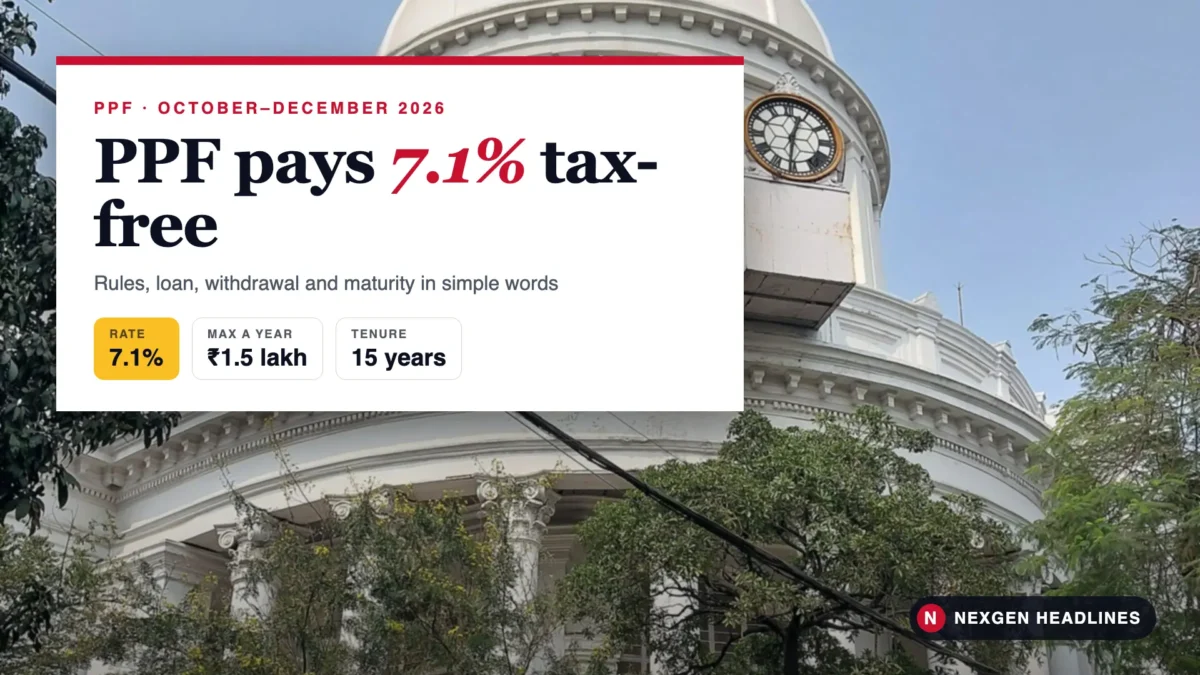
Featured image credit: General Post Office, Kolkata. Photo: Pinakpani / Wikimedia Commons, CC BY-SA 4.0; edited by Nexgen India