

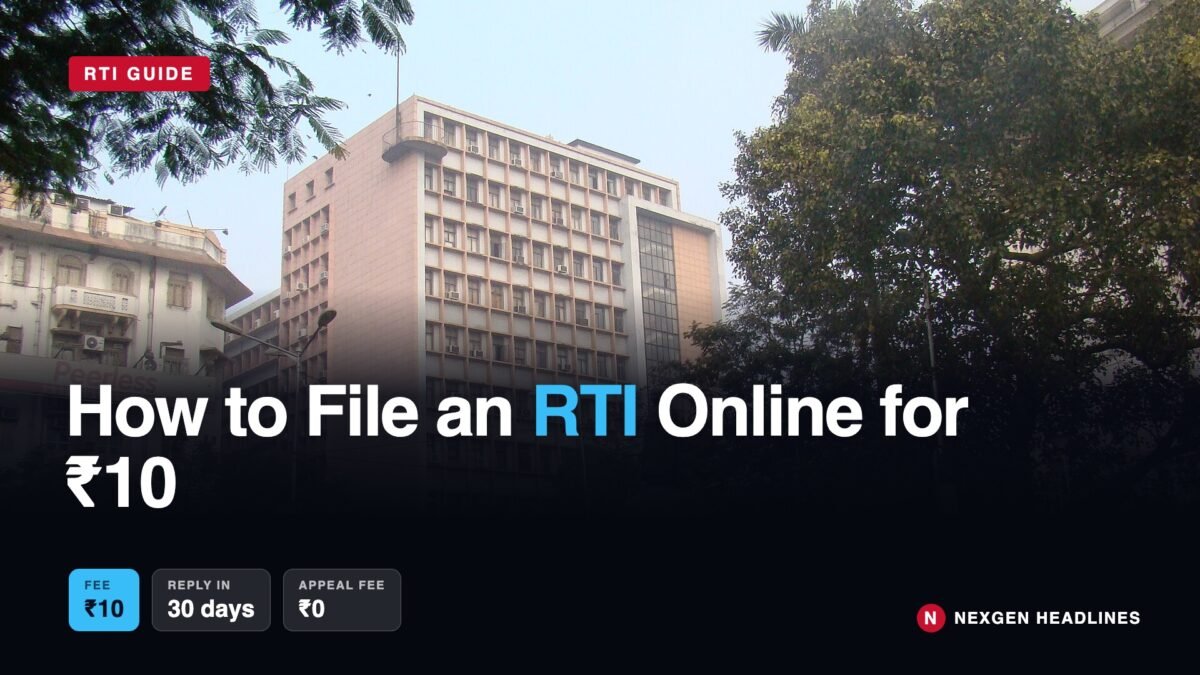
Quick answer: To file an RTI online for a central government office, go to rtionline.gov.in, choose the ministry or department, write your questions, and pay the ₹10 fee online. The office must reply within 30 days (48 hours if it concerns someone’s life or liberty). If it does not, you can file a free first appeal on the same portal.
At a glance
- Law: Right to Information Act, 2005
- Fee: ₹10 for central offices; BPL card holders do not pay
- Reply time: 30 days; 48 hours for life or liberty matters
- First appeal: within 30 days of the reply (or of the missed deadline); no fee centrally
- Second appeal: to the Central Information Commission within 90 days
- State offices: use your state’s own RTI portal or send a written application
How to file an RTI online: 7 steps
| Step | What to do |
|---|---|
| 1 | Open rtionline.gov.in and click Submit Request. |
| 2 | Read the guidelines and tick the box to continue. |
| 3 | Select the ministry, department or public authority from the list. |
| 4 | Fill your name, address, mobile number and email. Say whether you are BPL. |
| 5 | Type your questions in the text box (keep them short and clear), or upload a PDF. |
| 6 | Pay ₹10 by net banking, debit or credit card, or UPI. |
| 7 | Save the registration number you get by SMS and email. You need it to track and appeal. |
Which portal should you use?
The central portal, rtionline.gov.in, handles RTIs for central ministries, departments and many central public authorities. You cannot use it for your municipal corporation, state police or state departments.
For state bodies, check if your state has its own RTI portal. Many states do, such as Maharashtra, Tamil Nadu, Karnataka and Goa. If there is no portal, send a written application by post with the fee by postal order, demand draft or as your state rules allow.
| You want information from | Where to file |
|---|---|
| A central ministry (e.g. Railways, Finance, Home) | rtionline.gov.in |
| A central PSU or bank | rtionline.gov.in, if listed; else by post |
| A state department | State RTI portal, or by post |
| Municipal body, panchayat, state police | State portal or the office’s Public Information Officer |
How to write a strong RTI application
The RTI Act gives you a right to information that exists in records. It does not cover opinions, advice or “why” questions. Ask for documents, dates, numbers and file notings.
- Ask for specific records: “Copy of the file notings on my application number X.”
- Give a time period: “From 1 January 2026 to 30 September 2026.”
- Number your questions: 1, 2, 3.
- Keep it short. Central rules suggest about 500 words.
- Avoid “why” questions. Instead ask, “Provide the rule or order under which the decision was taken.”
Made-up example
Kavita in Bhopal (illustrative) applied for a passport re-issue three months ago. Her status page shows no change. She files an RTI with the Ministry of External Affairs asking:
- The current status of her application number, with the date of each stage.
- Names and designations of officers it is pending with.
- The rule or service standard on the time for processing such applications.
This is a made-up example to show how a clear RTI is written. RTI often pushes a stuck file to move.
Also read: How to Apply for a Passport Online in India: Step-by-Step Guide
Fees and extra charges
The application fee for central offices is ₹10. If the office has to send many pages, it can ask for copying charges, commonly ₹2 per page for A4 copies under central rules. You will see the demand under View Status on the portal, and can pay there.
If you hold a BPL card, you do not pay the fee. Upload a copy of your BPL certificate with the application.
If the office misses the 30-day deadline, it must give information free of charge.
What if you get no reply or a bad reply?
First appeal
If you get no reply in 30 days, or the reply is incomplete or wrong, file a first appeal. On the portal, click Submit First Appeal, enter your registration number and email, and explain what is missing. There is no fee for the first appeal on the central portal.
File it within 30 days of the reply, or of the date the reply was due. The appellate officer usually decides within 30 days, and can take up to 45 days.
Second appeal
If the first appeal fails, go to the Central Information Commission (CIC) within 90 days. For state offices, go to your State Information Commission. The commission can order disclosure and can fine an officer for unreasonable delay.
Information you usually cannot get
Section 8 of the Act lists exemptions. They include information that would harm national security, cabinet papers before a decision, personal information with no public interest, and some trade secrets.
Even then, the officer must give reasons for refusing. “Not available” or “too much work” alone is not a valid reason. You can challenge a refusal in appeal.
How to file an RTI by post
Online filing is fastest, but offline RTI works everywhere, including state and local offices.
- Write your application on plain paper, addressed to the Public Information Officer (PIO) of the office.
- Head it “Application under Section 6(1) of the RTI Act, 2005”.
- List your questions, then add your name, address, phone and signature.
- Attach the fee, by Indian Postal Order, demand draft or as your state’s rules allow.
- Send it by speed post or registered post, and keep the receipt as proof of the date.
You can also hand it in at the office counter. Ask for a dated acknowledgement.
Sample RTI questions that work
These are general templates. Change the names, numbers and dates to fit your case.
- “Provide the daily progress report of my application number ___, with dates of movement from one officer to another.”
- “Provide a copy of the sanctioned estimate and the work completion certificate for the road ___ in ward ___ for 2025-26.”
- “Provide the number of applications received and disposed of for ___ in the period ___ to ___.”
- “Provide the rule, circular or order that sets the time limit for deciding applications of this type.”
Questions like these ask for records the office already keeps, which makes refusal hard.
Common mistakes
- Filing with the wrong office. Pick the exact department that holds the record.
- Asking “why”. Ask for records, not explanations.
- Vague questions. “All details about road projects” gets rejected. Name the road, period and records.
- Losing the registration number. Save the SMS and email.
- Missing the appeal deadline. Mark 30 days and 90 days on your calendar.
- Paying agents. Filing is simple and costs ₹10. You do not need a middleman.
How to track your RTI
On rtionline.gov.in, click View Status. Enter your registration number, email and the captcha. You will see if the request was forwarded, replied to, or if fees are pending. Replies are often uploaded as PDFs on the same page.
Sometimes your RTI is transferred to another office that holds the record. The new office then has its own 30 days, counted from the transfer date.
Is RTI safe to use?
Yes, for everyday matters like a stuck application, a road repair or a pension file. Lakhs of citizens file RTIs every year. You only share a postal address so the reply can reach you.
If your question touches a sensitive local issue, keep it factual and polite. Ask for records, not accusations. Keep copies of everything you send and receive.
FAQ
What is the RTI fee?
₹10 for central government offices. BPL card holders are exempt. State fees can differ.
How long does an RTI reply take?
Up to 30 days, or 48 hours if it concerns a person’s life or liberty. Add 5 days if the application went through an assistant PIO.
Can I file an RTI for a state government office on rtionline.gov.in?
No. That portal is for central public authorities. Use your state’s portal or send it by post.
Do I need to give a reason for my RTI?
No. The Act says you do not have to give any reason for asking. Only give contact details needed to reply.
Can NRIs file RTI online?
The central portal is for Indian citizens. Many NRIs who are citizens file with Indian contact details, and pay online.
Bottom line
RTI is one of the cheapest and strongest tools an Indian citizen has. Pay ₹10, ask for specific records, and keep your registration number. If the office stays silent for 30 days, file the free first appeal. Most stuck files start moving once an RTI lands.
Last reviewed: 24 October 2026.
Sources: Right to Information Act, 2005 and RTI Rules, 2012 (Department of Personnel and Training); RTI Online portal guidelines; Central Information Commission (cic.gov.in). Example is illustrative. State fees and rules may differ.
Featured image credit: Aayakar Bhawan, Kolkata, a central government office building. Photo: Jayantanth / Wikimedia Commons, CC BY-SA 3.0; edited by Nexgen India

2 comments