Quick answer: To buy health insurance for parents who are senior citizens, compare plans on waiting period for existing diseases (now capped at 3 years by IRDAI), co-payment, room rent limits and network hospitals. There is no upper age limit to buy a new policy since IRDAI removed the 65-year cap in 2024. Individual health policies carry zero GST from 22 September 2025, and under the old tax regime you can deduct up to ₹50,000 a year for your senior citizen parents’ premium.
At a glance
- Age limit to buy: none; IRDAI removed the 65-year cap from 1 April 2024
- Pre-existing disease waiting period: maximum 3 years
- Moratorium: after 5 years of continuous cover, a claim cannot be rejected for non-disclosure (except proven fraud)
- GST: nil on individual and family floater policies from 22 September 2025
- Tax deduction (old regime): up to ₹50,000 for senior citizen parents
- Complaint: insurer first, then Bima Bharosa portal or Insurance Ombudsman
How to buy health insurance for parents: step by step
| Step | What to do | Why it matters |
|---|---|---|
| 1 | List your parents’ existing illnesses and medicines | You must declare them honestly |
| 2 | Decide the sum insured (₹10 lakh or more is common for metros) | Hospital costs are high for seniors |
| 3 | Compare 3–4 senior citizen or regular plans | Terms differ a lot |
| 4 | Check waiting period, co-pay, room rent and sub-limits | These decide how much you actually get |
| 5 | Check network hospitals near your parents’ home | Cashless treatment is easier |
| 6 | Complete pre-policy medical tests if asked | Common above 60 |
| 7 | Pay the premium online and save the receipt | Needed for the tax deduction |
| 8 | Read the policy within the free-look period | You can cancel if terms are not as promised |
Senior citizen plan vs family floater vs individual plan
| Option | Good for | Watch out for |
|---|---|---|
| Separate senior citizen plan | Parents above 60 with some health issues | Co-pay of 10–30% is common |
| Individual plan for each parent | Each parent gets a full sum insured | Two premiums to pay |
| Adding parents to your family floater | Rarely a good idea | Premium is based on the oldest member; one big claim uses up the cover for all |
| Super top-up plan | Adding extra cover at low cost | Pays only above a deductible amount |
Most advisers suggest a separate policy for parents, so your own family’s cover is not used up.
Key terms to compare
Waiting period for pre-existing diseases
Diabetes, high blood pressure and heart conditions are “pre-existing diseases” (PED). Claims for them are covered only after the waiting period. IRDAI rules from 2024 cap this at 3 years. Many plans offer shorter waiting periods, sometimes 1 or 2 years, or through an add-on.
Co-payment
Co-pay means you pay a fixed share of every claim. With a 20% co-pay on a ₹2 lakh bill, you pay ₹40,000. A lower co-pay usually means a higher premium.
Room rent limit
Some plans cap room rent, such as 1% of the sum insured per day. If you take a costlier room, other charges are cut in proportion. Choose “no room rent cap” or “single private room” if you can.
Sub-limits
Plans may cap payouts for cataract, knee replacement or other common senior surgeries. Check these limits carefully.
Restoration and no-claim bonus
Restoration refills your cover if it is used up in a year. A no-claim bonus raises the sum insured for each claim-free year.
Made-up example
Suresh, 34, lives in Pune and buys a ₹10 lakh plan for his parents, aged 64 and 61. His father has diabetes. The plan has a 2-year waiting period for diabetes and a 10% co-pay.
In year three, his father is admitted for a diabetes-related problem. The bill is ₹3 lakh. The insurer pays ₹2.7 lakh, and Suresh pays ₹30,000 as co-pay.
Suresh is in the old tax regime, so he claims up to ₹50,000 of the yearly premium as a deduction for his senior citizen parents.
This is a made-up example. Real premiums and terms depend on the plan and your parents’ health.
How much does it cost?
Premiums for senior citizens are high and depend on age, city, sum insured, health and co-pay. They can range from roughly ₹25,000 to over ₹1 lakh a year for two parents. Get real quotes, as prices change often. The removal of GST from 22 September 2025 has made individual policies about 18% cheaper than before for the same base premium, from the first renewal after that date.
Also read: Cashless health insurance claim rejected? What to do
Tax benefit on parents’ health insurance
Under the old tax regime (earlier Section 80D), you can deduct:
| Who is covered | Maximum deduction |
|---|---|
| Yourself, spouse and children (below 60) | ₹25,000 |
| Parents below 60 | ₹25,000 |
| Parents 60 or above | ₹50,000 |
| Preventive health check-up (within the above limits) | ₹5,000 |
The new tax regime does not give this deduction. Since the new Income-tax Act, 2025 started on 1 April 2026, the section number has changed, but the old regime benefit continues. Pay by any method other than cash, except for health check-ups.
Does Ayushman Bharat cover senior citizens?
Yes. Since October 2024, the Ayushman Vay Vandana card gives all senior citizens aged 70 and above health cover of up to ₹5 lakh a year under AB PM-JAY, regardless of income. It works at empanelled hospitals. Families can use it along with a private policy. Parents below 70 qualify only if their family is eligible under PM-JAY.
Common mistakes
- Hiding an illness. Non-disclosure is the biggest reason claims are rejected.
- Looking only at premium. A cheap plan with high co-pay and sub-limits can pay very little.
- Waiting until parents are older. Premiums rise and health issues add up.
- Relying only on your employer’s group cover. It ends when you change jobs or retire.
- Letting the policy lapse. You lose waiting period credit and continuity benefits.
- Ignoring porting. If you are unhappy, you can port to another insurer and keep waiting period credit.
How to file a claim
- For cashless, show the health card at a network hospital’s insurance desk.
- For planned treatment, ask the hospital to send pre-authorisation in advance.
- For reimbursement, keep all original bills, reports and the discharge summary.
- If a claim is denied, ask for the reason in writing.
- Complain to the insurer’s grievance officer, then to the Insurance Ombudsman if needed.
Checklist before you pay the premium
| Check | What to look for |
|---|---|
| Sum insured | ₹10 lakh or more for metro hospitals |
| PED waiting period | 3 years or less; shorter is better |
| Co-pay | 0–20%; avoid very high co-pay |
| Room rent | No cap or single private room |
| Sub-limits | None or high limits for cataract and joint surgery |
| Claim settlement record | Check the insurer’s data in IRDAI’s annual report |
| Network hospitals | Good hospitals near your parents’ home |
Porting an old policy for parents
If your parents already have a policy but are unhappy with service, you can port it to another insurer at renewal. The waiting period already completed carries over to the new policy, up to the old sum insured. Apply to the new insurer at least 15 days before the renewal date. The new insurer can still ask for medical tests and may decline. Do not let the old policy lapse until the new one is confirmed.
FAQ
Is there an age limit to buy health insurance for parents?
No. IRDAI removed the 65-year upper limit in 2024. Insurers must offer products for all ages, though premiums and conditions for older buyers are higher.
Can I add my parents to my family floater?
You can, but it is often not wise. The premium rises sharply, and a big claim by a parent can use up the whole family’s cover.
Is GST charged on senior citizen health insurance?
No, for individual and family floater policies from 22 September 2025. Group policies still attract GST.
How long is the waiting period for diabetes or BP?
At most 3 years under current IRDAI rules. Some plans offer shorter periods.
Can I claim tax deduction if my parents pay the premium?
No. The person who pays the premium claims the deduction, under the old regime only.
What sum insured is enough for parents?
Many families choose ₹10 lakh or more for parents in big cities, where a single heart or joint surgery can cost several lakh rupees. A base plan plus a super top-up is a cheaper way to get high cover.
Bottom line
Buy a separate policy for your parents, check the waiting period, co-pay and room rent rules, and declare every illness honestly. There is no age limit, no GST on individual policies, and up to ₹50,000 in tax deduction under the old regime. Start early, because cover only gets costlier with age.
Last reviewed: 13 November 2026. General information, not insurance advice. Read your policy wording before buying.
Sources: IRDAI, Business Standard: GST exemption on health policies, Income Tax Department, National Health Authority: AB PM-JAY, Council for Insurance Ombudsmen.
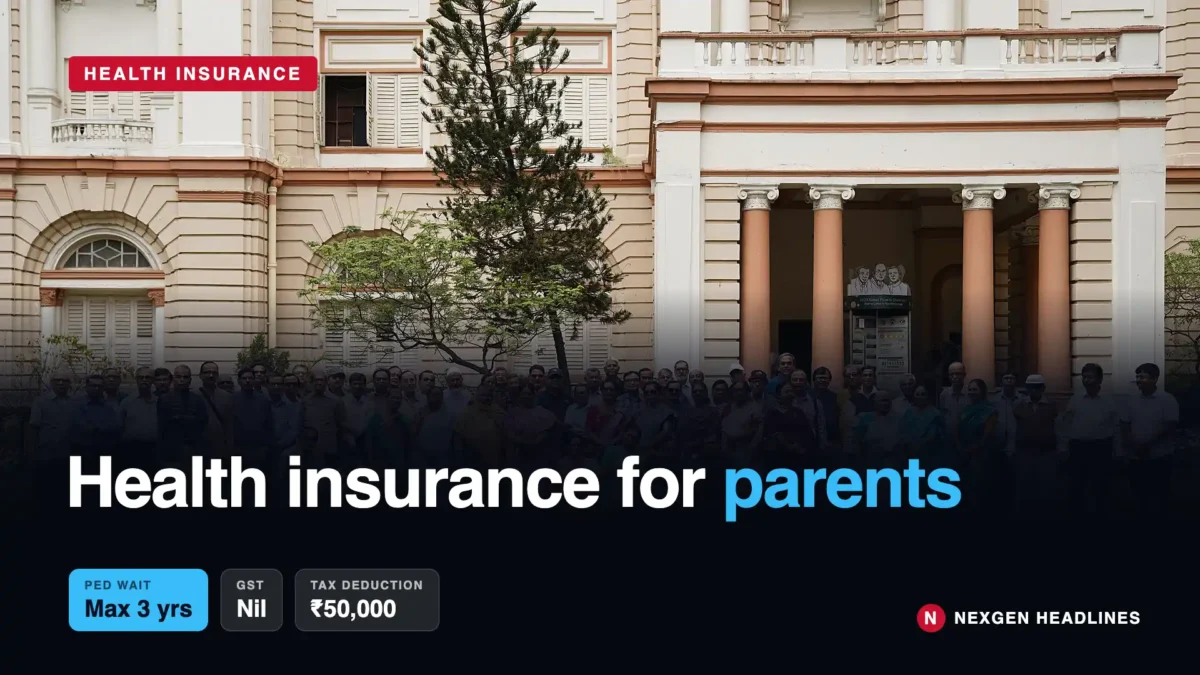
Featured image credit: Senior citizens group in Kolkata. Photo: Gangulybiswarup / Wikimedia Commons, CC BY 4.0; edited by Nexgen India