

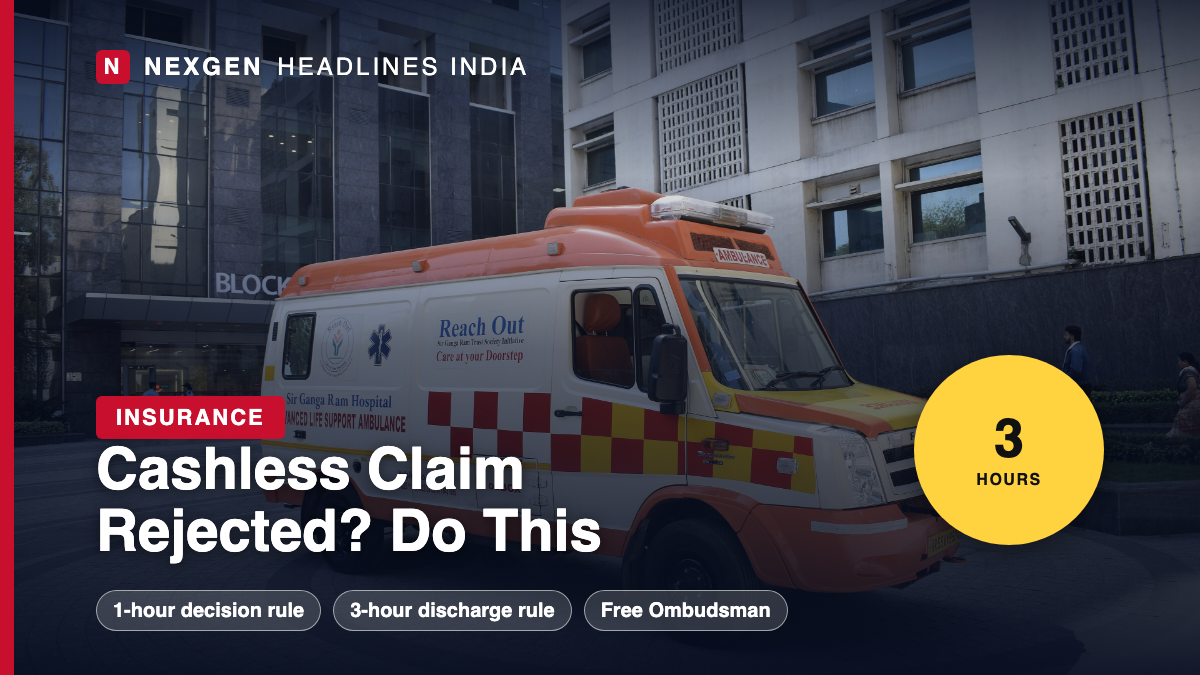
The worst time to learn how your health insurance works is at a hospital reception, with a relative on a bed and the insurer saying “cashless not approved”. These are the rules that protect you, and the exact order in which to use them.
At a glance
- IRDAI’s 2024 master circular: a cashless request should get a decision within 1 hour, and final discharge approval within 3 hours
- If the insurer is slow, the extra hospital charges are its responsibility, not yours
- A rejection should come with a written reason; ask for it
- Escalation path: insurer’s grievance officer, then IRDAI’s Bima Bharosa, then the Insurance Ombudsman
What it feels like
Imagine Ramesh in Jaipur (an illustrative example). His father is admitted for a planned surgery. The hospital sends a cashless request, and four hours later he is told it is “under review”. He is already pulling out his credit card to pay the deposit. Many families do exactly that, and then spend months chasing the reimbursement. The thing nobody tells you is that you have rights on the clock, from the first hour.
The time limits that apply
| Stage | What IRDAI’s master circular says |
|---|---|
| Cashless request at admission | Insurer should respond within 1 hour |
| Final authorisation at discharge | Within 3 hours of the hospital’s request; you should not be made to wait in the hospital |
| If the insurer misses 3 hours | The extra hospital charges are borne by the insurer |
Those rules come from IRDAI’s Master Circular on Health Insurance Products issued in May 2024. Official figures reported to Parliament show that most final authorisations are done inside three hours, but that still leaves some that are not.
If the claim or request is rejected
- Get the reason in writing. A phone call is not enough. Ask the insurer or TPA for a rejection or deficiency letter that lists the exact clause or missing document.
- Fix what can be fixed. Many rejections are about a missing discharge summary, an unclear diagnosis or a pre-existing-condition question. Reply with the document and keep a copy.
- Write to the Grievance Redressal Officer (GRO). Every insurer must have one. Send an email and note the reference number.
- Use Bima Bharosa. If the insurer does not resolve it, register the complaint on IRDAI’s portal, bimabharosa.irdai.gov.in.
- Approach the Insurance Ombudsman. If you are still not satisfied, the Ombudsman handles complaints without a fee. Act within one year of the insurer’s final reply.
Keep this file ready
Policy copy, premium receipts, the hospital’s estimate and bills, the discharge summary, every email and SMS from the insurer, and photos of the rejection letter. One folder on your phone is enough.
FAQ
Can the hospital delay my discharge because the insurer has not approved?
IRDAI’s circular says the policyholder should not be made to wait for discharge. If the insurer exceeds the three-hour window, it bears the extra charges.
Does interest apply to late claim payments?
Reports of IRDAI’s rules say delayed claim payments attract interest at 2% above the bank rate. Check your policy and the latest regulation for the exact trigger.
What if I just paid and want reimbursement?
File a reimbursement claim with all bills and the discharge summary, and keep the same documents handy for any later complaint.
Sources and fact-check
IRDAI Master Circular on Health Insurance Products (May 2024), as reported by The Tribune and PayBima. Parliamentary data on 96.69% of authorisations in 3 hours: Rajya Sabha / Lok Sabha replies, December 2025. This is general information, not legal or medical advice. Always confirm with the current IRDAI circulars. Checked on 20 October 2026.
Featured image credit: A hospital ambulance (file photo). Photo: Iankitkaushik / Wikimedia Commons, CC0; edited by Nexgen India

3 comments