


Quick answer: No Claim Bonus (NCB) is a discount on your car insurance own-damage premium for every claim-free year: 20%, 25%, 35%, 45%, then 50% after five years. It belongs to you, not the car, so you can move it to a new car. Renew within 90 days of expiry, or you lose it.
At a glance
- Slabs: 20% (1 year), 25% (2), 35% (3), 45% (4), 50% (5+ claim-free years)
- Applies to: the own-damage part of the premium, not third-party cover
- Belongs to: the policyholder; it moves with you, not the vehicle
- Lapse window: renew within 90 days of expiry to keep it
- One claim: usually resets NCB to zero, unless you have an NCB protector add-on
How to transfer NCB to a new car: 6 steps
| Step | What to do |
|---|---|
| 1 | Before selling your old car, tell your insurer you are selling it. |
| 2 | Ask for an NCB certificate (or NCB retention letter) in your name. |
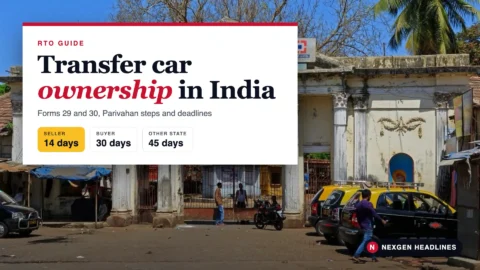
| 3 | Keep proof of sale: the sale deed or delivery note and Form 29/30 for RC transfer. |
| 4 | When buying the new car, give the NCB certificate to the new car’s insurer. |
| 5 | Check the new policy shows the right NCB percentage before paying. |
| 6 | Keep the new car’s registration in the same name as the old policy. |
How NCB works
A car policy has two parts. Third-party cover is mandatory by law and its rate is fixed. Own-damage cover pays for damage to your car. NCB is a discount only on the own-damage part.
For every policy year without a claim, the discount grows. After five claim-free years it reaches 50%, the maximum.
| Claim-free years | NCB on own-damage premium |
|---|---|
| 1 | 20% |
| 2 | 25% |
| 3 | 35% |
| 4 | 45% |
| 5 or more | 50% |
Made-up example
Rahul in Jaipur (illustrative) has an own-damage premium of ₹12,000 before discount. After five claim-free years, his 50% NCB cuts it to ₹6,000. He saves ₹6,000 a year.
One day he scrapes his bumper. The repair costs ₹5,000. If he claims, his NCB drops to zero next year, and his own-damage premium could go back to about ₹12,000. Paying the ₹5,000 himself is cheaper.
This is a made-up example. Real premiums depend on the car, city and insurer.
Should you claim for small damage?
Often, no. Before claiming, compare the repair cost with the NCB you would lose over the next few years. For small scratches and dents, paying yourself usually saves money.
Claim when the damage is large, when there is theft, or when another party is involved and a claim protects you legally.
Also read: FASTag Annual Pass 2026: Price, Trips and Is It Worth It?
The NCB protector add-on
An NCB protector lets you make a limited number of claims (often one or two a year) without losing your NCB. It costs extra and is available with comprehensive or standalone own-damage policies.
It is worth it if you have a high NCB (35-50%) and drive in heavy traffic where minor damage is common. Read how many claims it allows.
What happens when you switch insurers?
Your NCB moves with you. When you renew with a new insurer, give your previous policy copy. The new insurer checks your claim history and applies the right NCB.
Never declare “no claims” if you made one. If the insurer finds out later, it can reject a claim or cancel the policy.
Rules people often miss
- 90-day limit. If your policy lapses for more than 90 days, your NCB goes to zero. Many sources treat this as a hard deadline.
- Same owner. The new car must be registered in the same name as the old policy.
- Buyer does not get it. When you sell a car, the NCB stays with you. The buyer starts fresh and must transfer the policy to their name.
- Third-party only policies. They do not earn NCB, because there is no own-damage cover.
- Used-car purchases. Rules vary by insurer on applying your NCB to a second-hand car. Ask before buying.
What if something goes wrong?
Your new insurer did not apply the NCB
Send the NCB certificate or previous policy and ask for an endorsement. The insurer can refund the extra premium.
You lost the old policy papers
Download the policy from the old insurer’s website or app, or ask customer care for a copy.
Your policy lapsed
Renew as soon as possible. Within 90 days, NCB should be kept, though the car may need an inspection. After 90 days, it is lost.
The insurer refuses unfairly
Complain to the insurer’s grievance cell. If unresolved, go to the Insurance Ombudsman or the IRDAI Bima Bharosa portal.
Common mistakes
- Claiming small repairs. You can lose more in NCB than the repair costs.
- Letting the policy lapse. Set a reminder 15 days before expiry.
- Not asking for the NCB certificate when selling. Get it before handing over the car.
- Wrong name on the new car. If the RC is in a spouse’s name, the NCB may not transfer.
- Comparing only total premium. Check the insured declared value (IDV) and add-ons too.
How to save more at renewal
- Compare 3-4 insurers online using the same IDV and add-ons.
- Choose a voluntary deductible if you rarely claim.
- Drop add-ons you do not need, such as zero depreciation on an old car.
- Install an ARAI-approved anti-theft device, which some insurers reward with a discount.
- Pay on time and keep your NCB growing.
How NCB and IDV work together
Your premium also depends on the Insured Declared Value (IDV), which is roughly the current market value of your car. Insurers lower the IDV every year as the car gets older.
A lower IDV means a lower premium, but also a lower payout if the car is stolen or written off. Do not cut IDV too much just to lower the premium. Keep it close to what your car would sell for.
NCB is applied after the own-damage premium is worked out from the IDV. So a good IDV with a 50% NCB often gives the best value.
Claims that do not hit NCB
Some claims may not reduce your NCB, depending on your policy. Check the wording, but common examples are:
- Claims under a personal accident cover for the owner-driver.
- Claims under some add-ons, such as roadside assistance, at some insurers.
- Claims made by a third party against you, which fall under third-party cover.
Ask the insurer before filing whether a claim will affect your NCB. Get the answer in writing if possible.
Two-wheelers get NCB too
The same slabs usually apply to bike and scooter insurance. A rider with five claim-free years can get up to 50% off the own-damage premium. The 90-day lapse rule applies here as well, so renew on time.
Documents to keep for NCB
| Document | When you need it |
|---|---|
| Previous policy copy | Every time you switch insurers |
| NCB certificate or retention letter | When selling a car and buying a new one |
| Sale deed or delivery note | Proof that the old car was sold |
| Form 29/30 (RC transfer) | Proof of change of ownership |
| New car’s RC | To show the same owner name |
Keep scanned copies in DigiLocker or email. They save time when the new insurer asks.
FAQ
What is the maximum No Claim Bonus?
50%, after five or more claim-free years in a row.
Can I transfer NCB to my new car?
Yes. NCB belongs to you. Get an NCB certificate from your old insurer and keep the new car in your name.
What happens to NCB after a claim?
It usually resets to zero at the next renewal, unless you have an NCB protector add-on.
How long is NCB valid after a policy expires?
Renew within 90 days of expiry to keep it. After that, it is lost.
Does NCB reduce third-party premium?
No. NCB applies only to the own-damage premium.
Can I get NCB if I buy a car in my spouse’s name?
Usually not, because NCB belongs to the person who held the old policy. Some insurers allow a transfer between close family members in certain cases, like the death of the policyholder. Ask the insurer before you register the new car, so you can choose the right owner name.
Does NCB carry over if I switch from car to bike?
Generally no. NCB is transferred between vehicles of the same class, so car NCB moves to a car and bike NCB to a bike.
Bottom line
A 50% NCB can halve your own-damage premium. Protect it: avoid claims for small repairs, renew before expiry, and get an NCB certificate when you sell your car so you can carry the discount to your next one.
Last reviewed: 25 October 2026.
Sources: IRDAI motor insurance guidance (irdai.gov.in) and insurer explainers on NCB slabs and transfer from Bajaj Finserv, Digit Insurance and Jio Insurance Brokers. Transfer rules for used cars vary by insurer. Example is illustrative.
Featured image credit: Cars at Palsit Toll Plaza, NH-2, Burdwan. Photo: Biswarup Ganguly / Wikimedia Commons, CC BY 3.0; edited by Nexgen India

2 comments