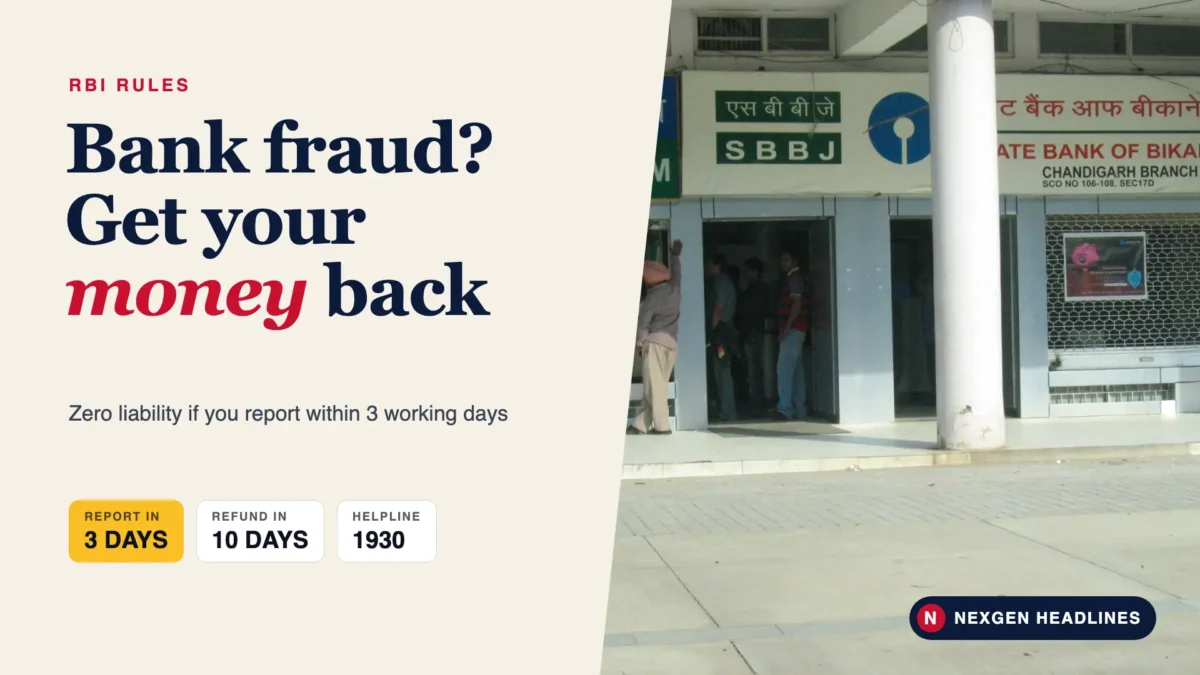
Quick answer: If money leaves your bank account or card without your permission, RBI rules say you have zero liability when the fault is the bank’s, or when you report a third-party fraud within 3 working days. Report in 4 to 7 working days and your loss is capped at ₹5,000 to ₹25,000, depending on the account. The bank must credit the disputed amount to your account within 10 working days of your complaint.
At a glance
- Rule: RBI circular on limiting customer liability in unauthorised electronic banking transactions (6 July 2017)
- Covers: net banking, debit and credit cards, mobile banking, UPI linked to bank accounts, ATM and online card fraud
- Zero liability: bank’s fault, or third-party fraud reported within 3 working days
- Limited liability: reported in 4–7 working days, ₹5,000 to ₹25,000 cap
- Shadow credit: money back in your account within 10 working days of reporting
- Final decision: within 90 days of the complaint
- Burden of proof: on the bank, not on you
What to do in the first hour: step by step
Speed decides how much of your money comes back. Do these steps in this order.
| Step | What to do | Why it matters |
|---|---|---|
| 1 | Block the card, UPI or net banking from your bank app, or call the bank’s 24×7 helpline | Stops more money going out |
| 2 | Call the national cyber fraud helpline 1930 | Police can ask banks to freeze the money in the fraudster’s account |
| 3 | Register a complaint with your bank in writing (app, email or branch) and note the complaint number | The 3-day clock is measured from the bank’s alert to your report |
| 4 | File a report on cybercrime.gov.in | Gives you an acknowledgement number for the bank and police |
| 5 | Save SMS alerts, emails, screenshots and call logs | Evidence for the bank and, later, the RBI Ombudsman |
| 6 | Check that the bank posts a “shadow credit” within 10 working days | This is your right under the RBI rule |
Who pays: the RBI liability rules explained
The RBI circular puts unauthorised transactions into three groups. Which group you fall into decides how much you lose, if anything.
1. Zero liability: the bank or the system failed
If the fraud happened because of the bank’s negligence or deficiency, you lose nothing. This is true even if you did not report it at once. Examples are a hacked bank server, a data leak from the bank, or a skimmer fitted on the bank’s own ATM.
2. Zero liability: third-party fraud reported fast
If neither you nor the bank is at fault, and the problem lies elsewhere in the system, you still lose nothing. The condition is that you inform the bank within 3 working days of getting the bank’s communication about the transaction.
This is why SMS and email alerts matter. The clock starts when the bank tells you, not when the money left.
3. Limited liability: reported in 4 to 7 working days
If you report the same kind of third-party fraud in 4 to 7 working days, your loss is the transaction amount or the cap below, whichever is lower.
| Type of account | Maximum liability (4–7 working days) |
|---|---|
| Basic Savings Bank Deposit (BSBD) accounts | ₹5,000 |
| Other savings accounts; prepaid cards and gift cards; current, cash credit or overdraft accounts of MSMEs; current, cash credit or overdraft accounts of individuals with annual average balance or limit up to ₹25 lakh; credit cards with limit up to ₹5 lakh | ₹10,000 |
| All other current, cash credit or overdraft accounts; credit cards with limit above ₹5 lakh | ₹25,000 |
4. Reported after 7 working days
Beyond seven working days, your liability depends on the bank’s board-approved customer protection policy. Many banks still help, but you lose the fixed protection. Every bank publishes this policy on its website.
5. When you are at fault
If the loss happened because you shared your OTP, PIN, CVV or password, you bear the whole loss until you report it. After you report, the bank is responsible for any further loss.
Fraudsters know this rule. That is why scam calls push you to “read out the OTP for verification”. No bank, RBI official or police officer will ever ask for it.
Example (made-up, for illustration)
Anita in Pune gets an SMS on a Friday night: ₹18,500 spent on her debit card at an online store she never used. She did not share any OTP. She blocks the card in her bank app, calls 1930 and emails the bank before midnight. Within a week, the bank puts ₹18,500 back as a shadow credit while it investigates. Because she reported within 3 working days and did not share details, her liability is zero.
Her cousin Rahul notices a similar ₹12,000 debit on his savings account only after 6 working days. He also shared nothing. His liability is capped at ₹10,000, the limit for a regular savings account. If he had waited beyond 7 working days, his bank’s own policy would decide.
What is a “shadow credit” and when should it arrive?
A shadow credit is the bank putting the disputed amount back into your account while it investigates. The RBI rule says the bank must do this within 10 working days from the date you report.
The bank may mark the money as under lien or blocked till the case is settled. But for a credit card, you should not have to pay the disputed amount or interest on it during this time. For a savings account, the bank should not make you lose interest.
The bank must resolve the complaint and decide liability within 90 days. If it cannot, the RBI rule says the customer is to be compensated as if it were a zero-liability case.
Also read: How to report cyber fraud on 1930 and the cybercrime portal
Which transactions does this rule cover?
The RBI circular covers electronic banking transactions. In daily life that means:
- Remote or online payments where the card is not present: online shopping, net banking, mobile banking and prepaid instruments.
- Card-present payments: ATM withdrawals and swipes at shops (POS).
- UPI payments that debit your bank account are electronic transactions; banks generally handle them under the same customer protection policy.
It does not cover cases where you willingly sent money to a scammer, for example after a fake job offer or “investment” pitch. These are authorised payments, even if you were tricked. Still call 1930 at once. Quick reporting can freeze the money before it is withdrawn.
How to write your complaint to the bank
Keep it short and factual. Include these points:
- Your name, account or card number (last four digits only in email), and mobile number.
- Date, time and amount of each disputed transaction.
- A clear line: “I did not authorise these transactions and did not share my OTP, PIN or password.”
- Your 1930 or cybercrime.gov.in acknowledgement number.
- A request for a shadow credit under the RBI circular of 6 July 2017.
Ask for a complaint number and keep it. Banks must give you an acknowledgement with the date and time of your report. That record proves you reported within 3 working days.
If the bank says no or does not reply
Banks sometimes delay or claim you shared an OTP. Remember: the burden of proving your liability is on the bank. Here is how to escalate.
| Level | Where | When |
|---|---|---|
| 1 | Bank’s grievance officer or nodal officer (details on the bank website) | If the branch or call centre does not help |
| 2 | RBI Ombudsman at cms.rbi.org.in | No reply in 30 days, or you are unhappy with the reply |
| 3 | Consumer commission via e-Daakhil / e-Jagriti | If you want compensation for harassment as well |
The RBI Ombudsman complaint is free. You can file online in a few minutes. Attach your bank complaint, the bank’s reply (if any), SMS alerts and the 1930 acknowledgement.
Common mistakes that cost people money
- Waiting for the weekend to end. The 3 working days start from the bank’s alert. Block and report the same day, even on a Sunday, through the app or helpline.
- Not registering a mobile number for SMS alerts. RBI rules ask banks to make customers register for alerts. Without alerts, you may not notice fraud in time.
- Calling a “customer care” number from Google. Fake numbers are common. Use the number on the back of your card or on the bank’s official site.
- Only telling the police. The bank also needs a complaint from you. The RBI time limit is about reporting to the bank.
- Deleting SMS or WhatsApp messages. Keep every message and screenshot as evidence.
How to protect your account from now on
- Turn on SMS and email alerts for every transaction.
- Set daily limits for UPI, cards and net banking in your bank app.
- Switch off international and online card use when you do not need it.
- Never share OTP, PIN, CVV or screen-sharing access with anyone.
- Do not install apps like AnyDesk or TeamViewer on a caller’s request.
- Check your statement every week, not only at month end.
FAQ
Will the bank refund money lost in online fraud?
Yes, in most cases, if you did not share your OTP or PIN and you report within 3 working days. Your liability is then zero under RBI rules.
How many days does a bank take to refund fraud money?
The bank must give a shadow credit within 10 working days of your report. It must settle the complaint within 90 days.
What if I shared my OTP with the fraudster?
You bear the loss until you report it to the bank. After reporting, the bank bears any further loss. Still call 1930 quickly, as money can sometimes be frozen.
Does the rule apply to credit cards?
Yes. Credit cards up to ₹5 lakh limit have a ₹10,000 cap for reports in 4–7 working days. Higher-limit cards have a ₹25,000 cap.
Are Sundays and bank holidays counted?
The RBI rule uses working days, so holidays are not counted. But do not wait. Report at once through the app or the 24×7 helpline.
Bottom line
RBI rules protect you well, but only if you are fast. Block, call 1930 and complain to the bank within 3 working days, and your liability for a fraud you did not cause is zero. Expect the money back as a shadow credit within 10 working days. If the bank stalls, go to the RBI Ombudsman.
Last reviewed: 9 November 2026. Based on the RBI circular of 6 July 2017. Check your bank’s customer protection policy for cases reported after 7 working days.
Sources: RBI: Limiting liability of customers in unauthorised electronic banking transactions, RBI Complaint Management System, National Cyber Crime Reporting Portal, Business Standard.
Featured image credit: State Bank ATM in Chandigarh. Photo: Ajay Tallam / Wikimedia Commons, CC BY-SA 2.0; edited by Nexgen India