

It usually happens fast. A call from “your bank”, a link to “update KYC”, a too-good part-time job, or a screen-share request from a “customer care” number you found online. By the time you realise something is wrong, the money has already left your account.
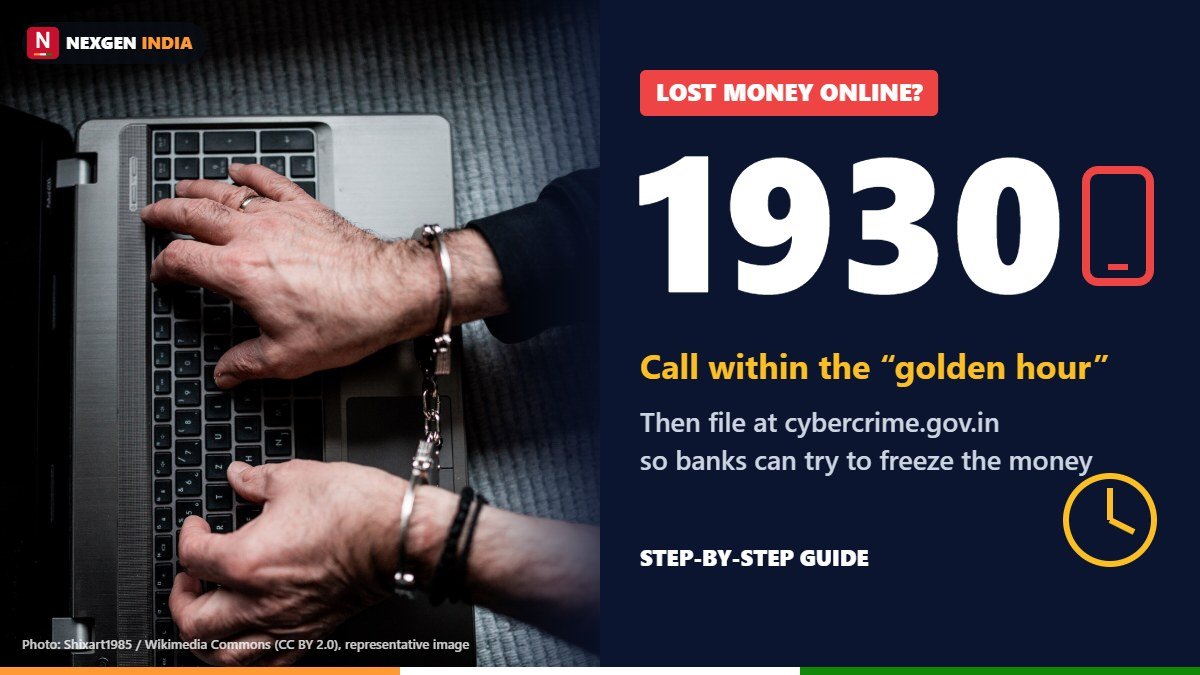
First, breathe. Then act quickly, because speed really does matter here. India has a national system built for exactly this moment: the 1930 helpline and the cybercrime.gov.in portal. Used in the right order and fast enough, they can help banks freeze stolen money before fraudsters move it again. This guide walks you through what to do in the first hour, the first day, and the weeks after.
At a glance
- Lost money? Call 1930 first, as soon as possible. This is the national cyber fraud helpline.
- Then file a written complaint on cybercrime.gov.in and save the acknowledgement or complaint number.
- Tell your bank at once and ask them to block your card, UPI or net banking.
- Keep every screenshot, SMS and transaction ID (UTR). Don’t delete the chat with the fraudster.
- Never pay anyone who promises to “recover” your money for a fee. That is usually a second scam.
Short on time? See the whole guide in our 1-minute Web Story.
Why the first hour matters so much
Fraudsters rarely keep stolen money in one account. Within minutes they split it, move it through “mule” accounts, buy gift cards or withdraw cash. Each hop makes it harder to trace and freeze.
When you report quickly through 1930, the details go into a system that alerts the banks and payment apps involved, so they can try to put a hold on the money while it is still sitting in an account. Police and cyber cells across states often call this the “golden hour”. There is no guarantee, but early reports have a far better chance than ones made days later.
Did you know?
Calling 1930 and filing on cybercrime.gov.in are free. No police officer, bank or government portal will ask you to pay a fee to register a complaint or to get your money back.
Step 1: Call 1930 and keep these details ready
Call 1930 from your phone. Try to keep the following in front of you before you dial, so the call is quick and accurate:
- Your name, mobile number and address
- Your bank or wallet name and account details (never share your PIN, password or OTP, even on this call)
- Amount lost, and the date and time of each transaction
- Transaction reference numbers: UTR for UPI and IMPS, or the reference ID in your bank SMS
- The fraudster’s phone number, UPI ID, website, app name or social media profile, if you have it
After the call you may receive an SMS with an acknowledgement number. Write it down and screenshot it. You’ll need it to complete and follow up on your complaint.

Step 2: File the complaint on cybercrime.gov.in
The phone call starts the clock, but a written complaint creates the official record. Do it the same day if you can.
- Open cybercrime.gov.in (check the spelling and the “.gov.in” ending) and click File a Complaint.
- Choose the option for reporting cyber crime other than women and child related cases, then register or log in with your name and mobile number. An OTP will come to your phone.
- Pick the category that fits, such as Online Financial Fraud, and fill in what happened: date, time, how you were contacted, and what you paid.
- Add the suspect’s details you have: phone number, UPI ID, account number, website or app.
- Upload evidence: screenshots of chats and payment screens, bank SMS, and your statement page showing the debit.
- Submit and save the complaint / acknowledgement number. You can track the status later on the same portal.
Write your complaint plainly and in order, as if you’re explaining it to a friend: “On 14 October at around 2:10 pm I got a call from…”. Clear, factual complaints are easier for the cyber cell to act on.
Report it quickly, report it accurately, and keep every piece of evidence. That’s the single most useful thing a victim can do.
Common advice from state cyber police units
Step 3: Call your bank, right now
While the complaint is being processed, protect what’s left. Call your bank’s official customer care number (from the back of your card or the bank’s own website, never from a search result) and ask them to:
- Block your debit or credit card, UPI and net banking if they could be misused
- Mark the fraudulent transactions as disputed and give you a reference number
- Share the complaint reference in writing or by email
Under RBI rules for unauthorised electronic transactions, how quickly you inform your bank affects how much of the loss you may have to bear. Customers who report a fraud that happened because of a third-party breach within three working days generally have zero liability, and the protection shrinks after that. Rules differ when the customer shared an OTP or PIN, so report fast either way.
| When | What to do | Why |
|---|---|---|
| First minutes | Call 1930 and your bank | So money can be flagged and accounts blocked |
| Same day | File on cybercrime.gov.in with screenshots | Creates the official written record |
| Within 3 working days | Make sure your bank has a written dispute | RBI liability rules depend on how fast you report |
| Next weeks | Track the complaint, respond to police or bank calls | Recovery, if possible, goes through official channels |
What if you didn’t lose money but got a scam call or message?
Not every fraud attempt succeeds. If you got a suspicious call, SMS or WhatsApp message and didn’t pay, you can still help stop it. Report it on the Chakshu facility of the government’s Sanchar Saathi portal (sancharsaathi.gov.in), which is meant for suspected fraud communication. Reports like these help authorities act against numbers used for scams.
If your phone itself was stolen along with your banking apps, block the handset through Sanchar Saathi as well. We explain that step by step in our Hindi guide to blocking a lost or stolen phone.
What this means for you
Speed beats perfection. Call 1930 even if you don’t have every detail yet.
- Change passwords and UPI PINs for any account the fraudster may have seen.
- Uninstall any “screen sharing” or remote access app you were asked to install.
- Warn family members, especially parents, about the exact trick used on you. Scammers often reuse the same script.
Watch out for the “recovery” scam
Here’s the cruel part. After people post about a fraud online, they are often contacted by “agents”, “lawyers” or “cyber experts” who promise to get the money back for an advance fee. Real recovery happens only through your bank, the police and the courts. Anyone asking for money to recover money is almost certainly running a second scam.

Will I get my money back?
Honestly, it depends. If the money was frozen in time, it can be returned through the bank and police process, sometimes after a court order, and that can take weeks or months. If it was withdrawn or moved abroad quickly, recovery is harder. Reporting fast and keeping evidence gives you the best chance, and it also helps police catch the network behind the fraud.
Your questions, answered
What is the 1930 helpline?
1930 is India’s national helpline for reporting financial cyber fraud. Calling it quickly helps alert banks and payment apps so stolen money can be put on hold.
How do I file a cyber crime complaint online?
Go to cybercrime.gov.in, click File a Complaint, register with your mobile number and OTP, choose the category such as online financial fraud, add details and evidence, and submit. Save the complaint number to track it.
Is there a fee to report cyber fraud?
No. Calling 1930 and filing on cybercrime.gov.in are free. Anyone charging a fee to “recover” your money is likely a scammer.
Should I also tell my bank?
Yes, immediately. Ask them to block your card, UPI or net banking and record the transactions as disputed. Under RBI rules, reporting within three working days can limit your liability in many cases.
Your turn
Has someone you know faced an online fraud? What trick did the scammer use? Share it in the comments without personal details, and it could stop the next person from falling for it.
Sources: National Cyber Crime Reporting Portal (cybercrime.gov.in), Sanchar Saathi (sancharsaathi.gov.in), RBI circular on customer liability in unauthorised electronic banking transactions, state cyber police advisories. Last reviewed 14 October 2026.



4 comments