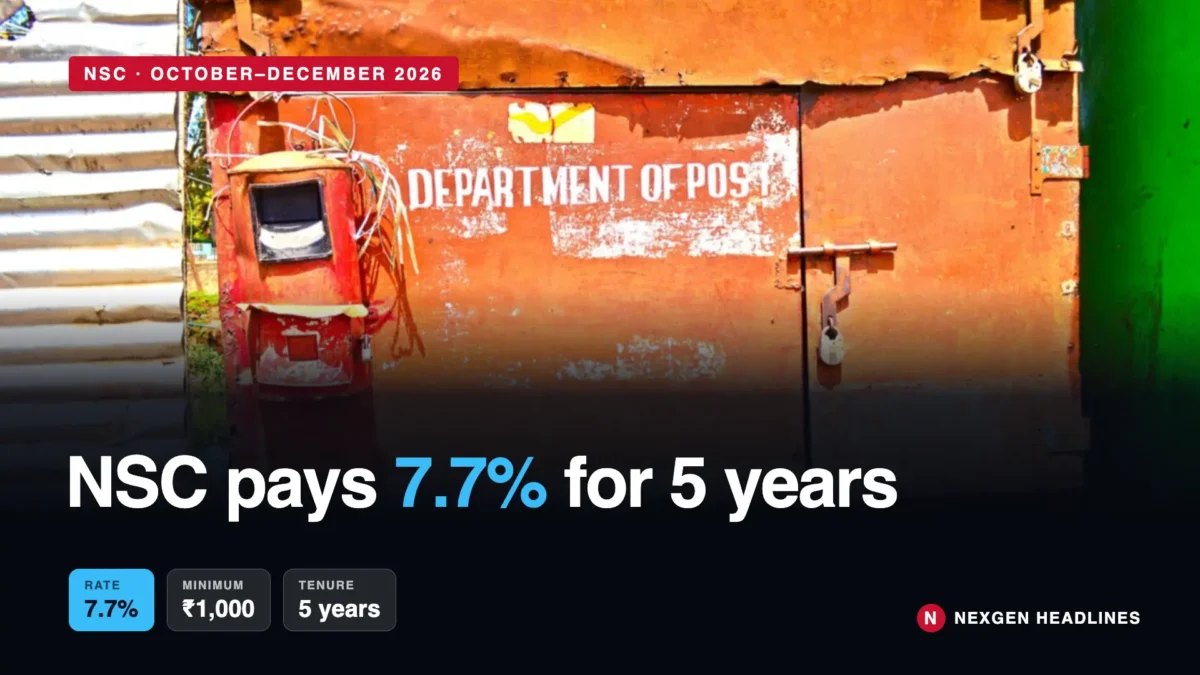
Quick answer: The National Savings Certificate (NSC) pays 7.7% a year for October to December 2026, compounded yearly and paid at maturity after 5 years. ₹1 lakh grows to about ₹1.45 lakh. The minimum is ₹1,000 with no upper limit, and deposits up to ₹1.5 lakh qualify for Section 80C under the old tax regime. The interest is taxable.
At a glance
- Interest rate: 7.7% a year (October–December 2026), compounded yearly, paid at maturity
- Tenure: 5 years
- Minimum: ₹1,000, then multiples of ₹100; no maximum
- Tax benefit: Section 80C up to ₹1.5 lakh (old regime only)
- Tax on interest: Taxable, but yearly accrued interest (except the last year’s) counts as a fresh 80C investment
- Early exit: Generally not allowed, except death, court order or pledge forfeiture
- Where: Any post office; online through post office internet banking or IPPB for some accounts
How to buy NSC: step by step
| Step | What to do |
|---|---|
| 1 | Visit your post office, or log in to India Post internet banking if you have a linked savings account |
| 2 | Fill the NSC application form (Form 1) |
| 3 | Submit KYC: Aadhaar, PAN and a photo |
| 4 | Pay by cash, cheque or from your post office savings account |
| 5 | Add a nominee |
| 6 | Collect the e-certificate or passbook confirmation and keep it safe |
How much will NSC give you?
NSC interest is compounded every year but paid only when the certificate matures. At 7.7%, the money grows by about 45% in five years.
| Investment | Approx. value after 5 years at 7.7% | Total interest |
|---|---|---|
| ₹1,000 | ₹1,449 | ₹449 |
| ₹50,000 | ₹72,452 | ₹22,452 |
| ₹1,00,000 | ₹1,44,903 | ₹44,903 |
| ₹1,50,000 | ₹2,17,354 | ₹67,354 |
The rate at the time you buy stays fixed for your certificate’s full 5 years, even if the government changes the rate later.
The NSC tax trick most people miss
NSC interest is taxable, but there is a useful rule under the old tax regime.
- Each year, the interest your NSC earns is treated as reinvested.
- That reinvested interest counts as a fresh Section 80C investment for years 1 to 4.
- So you show the interest as income, and also claim it under 80C. The net tax effect is often zero for those years, if you have 80C room left.
- In year 5, the interest is paid out, so it is fully taxable with no 80C claim.
Under the new tax regime, there is no 80C, so all NSC interest is simply taxable at your slab rate.
Made-up example
These are made-up examples to explain the maths. Suresh Patel, 38, from Ahmedabad, is in the old tax regime. In March he puts ₹50,000 in NSC to finish his 80C limit.
In the first year, his NSC earns about ₹3,850. He adds it to his income in the ITR, and also claims it under 80C because he still has room. After five years, he gets about ₹72,452. Only the last year’s interest is taxed without an 80C offset.
NSC vs PPF vs tax-saving FD
| Feature | NSC | PPF | 5-year tax-saving FD |
|---|---|---|---|
| Rate | 7.7% (Oct–Dec 2026) | 7.1% | Varies by bank |
| Lock-in | 5 years | 15 years | 5 years |
| 80C | Yes (old regime) | Yes (old regime) | Yes (old regime) |
| Interest tax | Taxable | Tax-free | Taxable, with TDS |
| TDS | No | No | Yes, above the limit |
| Rate fixed? | Yes, for 5 years | No, changes quarterly | Yes |
NSC suits people who want a fixed 5-year return and an 80C option, without locking money for 15 years. PPF suits long-term, tax-free saving.
Can you withdraw NSC early?
Usually, no. NSC can be encashed before maturity only in a few cases:
- Death of the holder, or any one holder in a joint certificate
- Forfeiture by a pledgee who is a gazetted government officer
- An order of a court
If you may need the money in under five years, NSC is not the right choice. Keep emergency money in a savings account or a flexible FD.
Buying NSC for family members
You can buy NSC in your spouse’s or adult child’s name, but they must be the holder with their own KYC. For a child under 10, a parent buys it as guardian. If you want the 80C deduction yourself, the safest choice is to buy the NSC in your own name. Ask a tax adviser before claiming 80C on a certificate held by someone else.
Using NSC as loan security
NSC can be pledged to banks and some lenders as security for a loan. This gives you access to money without breaking the certificate. The bank decides the loan amount and rate. Ask your post office for the transfer-and-pledge form.
Who can buy NSC?
- Any resident Indian adult
- Joint holding by up to three adults
- A guardian on behalf of a minor, or a person of unsound mind
- A minor aged 10 or above in his or her own name
NRIs cannot buy new NSCs. HUFs and trusts are also not allowed under current rules.
What happens at maturity?
When the 5 years end, you can collect the money at the post office, or it can be credited to your linked post office savings account. If you don’t claim it, the matured amount may earn only the post office savings rate, so collect or reinvest it on time.
Many people roll it into a fresh NSC to keep the 80C cycle going.
Common mistakes with NSC
- Forgetting to show yearly interest in the ITR. It is income even though you don’t receive it.
- Buying in the new tax regime for 80C. There is no 80C in the new regime.
- Not adding a nominee.
- Losing the certificate details. Save a photo of the e-certificate and receipt.
- Using NSC for money you may need soon. Early exit is very limited.
Documents you need
- Aadhaar card
- PAN card
- Passport-size photo
- Address proof, if Aadhaar address is old
- Nominee details
Year-by-year growth of ₹1 lakh in NSC
This table shows how ₹1,00,000 grows each year at 7.7%. The “accrued interest” column is the amount you show in your ITR each year.
| Year | Accrued interest | Value at year end | 80C claim (old regime) |
|---|---|---|---|
| 1 | ₹7,700 | ₹1,07,700 | Yes |
| 2 | ₹8,293 | ₹1,15,993 | Yes |
| 3 | ₹8,931 | ₹1,24,924 | Yes |
| 4 | ₹9,619 | ₹1,34,544 | Yes |
| 5 | ₹10,360 | ₹1,44,903 | No, fully taxable |
Figures are rounded to the nearest rupee.
Should you choose NSC or a bank FD?
A bank FD is more flexible. You can usually break it early with a small penalty, and many banks offer senior citizens an extra rate. But FD interest attracts TDS above the yearly limit, and the rate depends on the bank.
NSC has no TDS and a government-backed fixed rate, but you can’t take the money out early. Pick NSC for money you are sure you won’t touch for five years. Pick an FD for money you may need.
How to show NSC interest in your ITR
- Work out the year’s accrued interest (see the table above).
- Show it under “Income from Other Sources.”
- If you are in the old regime and have 80C room, claim the same amount under 80C for years 1 to 4.
- In year 5, show the interest as income with no 80C claim.
Who should skip NSC
- New tax regime users who want tax-free returns. NSC interest is fully taxable for you. PPF may suit you better.
- People in the 30% slab without 80C room. After 30% tax plus 4% cess, the real return drops to about 5.3%.
- Anyone who may need the money for a wedding, fees or medical costs within five years.
- Young investors with a long horizon who can take some market risk. An equity SIP may grow more over 10+ years, though with ups and downs.
For everyone else, especially careful savers and those close to retirement, NSC is a clean, predictable choice.
Also read: Old vs new tax regime: which one saves you more?
FAQ
What is the NSC interest rate for October–December 2026?
7.7% a year, compounded yearly and paid at maturity after 5 years.
How much will ₹1 lakh in NSC become?
About ₹1,44,903 after 5 years at 7.7%.
Is NSC interest tax-free?
No. It is taxable. Under the old regime, the yearly accrued interest for the first four years can be claimed under 80C as reinvestment.
Is there TDS on NSC?
No TDS is cut on NSC interest, but you must still show it in your ITR.
Can I break NSC before 5 years?
Only in special cases such as the holder’s death, a court order or pledge forfeiture.
Bottom line
NSC is a simple, government-backed 5-year saving with a fixed 7.7% rate. It works best for old-regime taxpayers who want to fill 80C without a 15-year lock-in. Show the yearly interest in your ITR, add a nominee, and don’t put emergency money in it.
Last reviewed: 3 November 2026
Sources: India Post (NSC rules); Department of Economic Affairs, Ministry of Finance (small savings rates, office memorandum of 30 September 2026); National Savings Institute; Income Tax Department; Free Press Journal (PTI). General information, not financial advice.
Featured image credit: India Post office, Ooty. Photo: Subhashish Panigrahi / Wikimedia Commons, CC BY-SA 4.0; edited by Nexgen India