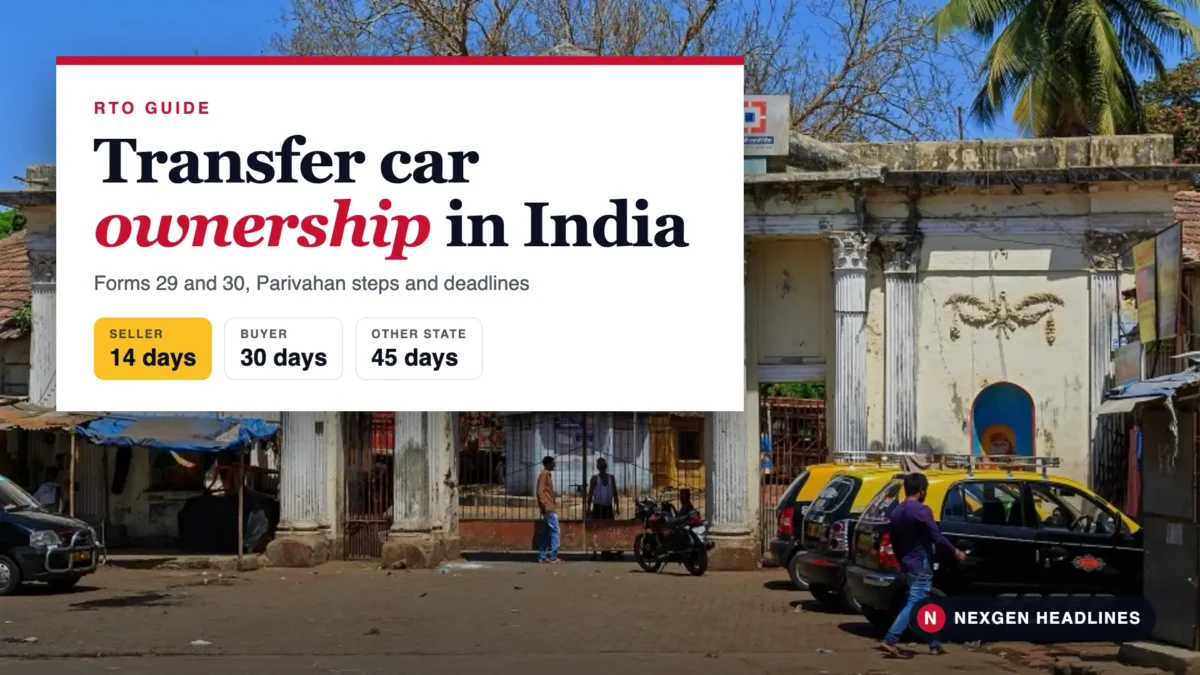
Quick answer: To transfer car ownership in India, the seller signs Form 29 (notice of transfer) and both seller and buyer sign Form 30 (application for transfer). The buyer applies online on the Parivahan Vahan portal, pays the state’s fee, and submits the original RC and documents at the RTO. Under Section 50 of the Motor Vehicles Act, the seller must report the sale within 14 days (same state) or 45 days (other state), and the buyer must apply within 30 days. Then move the car insurance to the buyer’s name.
At a glance
- Key forms: Form 29 (2 copies), Form 30; Form 28 NOC if moving to another RTO/state; Form 35 if the car had a loan
- Where: parivahan.gov.in → Vahan → Online services → Transfer of Ownership
- Seller deadline: 14 days within the state, 45 days if the car goes to another state
- Buyer deadline: 30 days to apply for transfer
- Fees: set by each state; shown on the portal before payment
- After: new RC (smart card) by post or ready for collection; transfer insurance too
Car ownership transfer: step-by-step
| Step | Who | What to do |
|---|---|---|
| 1 | Seller | Clear any loan; get Form 35 and the bank’s NOC if the RC shows hypothecation |
| 2 | Seller + buyer | Sign a sale letter/delivery note with date, time, price and odometer reading |
| 3 | Seller + buyer | Sign Form 29 (2 copies) and Form 30 |
| 4 | Buyer | Apply on Parivahan Vahan: Transfer of Ownership, enter the registration number and chassis last 5 digits |
| 5 | Buyer | Fill details, upload documents, pay the fee online |
| 6 | Buyer | Book an RTO slot if your state needs it; submit original RC and signed forms |
| 7 | RTO | Verifies and issues the new RC in the buyer’s name |
| 8 | Buyer | Transfer the insurance policy to your name |
Why the transfer matters (especially for the seller)
Until the RC changes, the seller is still the registered owner in government records. That means:
- Traffic e-challans may go to the seller’s mobile.
- If the car is involved in an accident or crime, police contact the registered owner first.
- Third-party insurance claims can become messy.
So sellers should not just hand over the keys and signed forms. Follow up until the RC shows the new owner’s name. You can check on the Vahan “Know your vehicle details” service or on mParivahan.
Documents needed
From the seller
- Original Registration Certificate (RC)
- Signed Form 29 (2 copies) and Form 30
- Form 35 and bank NOC if the car had a loan
- Form 28 (NOC) if the buyer lives under another RTO or another state
- Seller’s ID and address proof (self-attested copy)
From the buyer
- Address proof (Aadhaar, passport, utility bill, as accepted)
- PAN card copy or Form 60
- Valid insurance certificate
- Valid PUC (pollution under control) certificate
- Passport-size photos, if asked
- Chassis and engine number pencil print, if your RTO asks
How to apply online on Parivahan (Vahan)
- Go to parivahan.gov.in and open Online Services → Vehicle Related Services.
- Choose your state and RTO, or enter the vehicle registration number.
- Select Transfer of Ownership.
- Enter the registration number and the last five characters of the chassis number; verify with OTP.
- Fill in the buyer’s details and the transfer reason (sale).
- Upload scanned documents.
- Pay the fee online. Save the receipt and application number.
- Book an appointment if your state needs physical verification, and submit the originals.
Some states now allow a fully faceless transfer using Aadhaar authentication of both parties. Check your state transport department’s site.
Made-up example (for illustration): Priya sells her 2019 hatchback to Arjun in the same city in Pune. They sign a delivery note at 4 pm, plus Forms 29 and 30. Arjun applies on Vahan the next day, pays the fee and submits the RC at the RTO in the following week. Meanwhile, Priya keeps a photocopy of the signed forms and the delivery note. A week later, a speeding challan dated after the sale comes to her phone. She shows the delivery note with date and time, proving Arjun had the car, and the challan is sorted.
Transfer to another state
If the buyer lives in another state, the process has extra steps:
- The seller gets Form 28 NOC from the original RTO.
- The seller reports the sale within 45 days.
- The buyer registers the car in the new state, which usually means paying that state’s road tax.
- The buyer may claim a refund of unused road tax from the old state, as that state’s rules allow.
Note: the BH (Bharat) series number has its own rules for people who move states often. Ask your RTO.
Transfer after the owner’s death
When a car owner dies, the legal heir or nominee can apply to transfer the vehicle using Form 31, with the death certificate and proof of succession. The rules give 30 days for reporting the death, and three months for the transfer application. Some states let you name a nominee on the RC, which makes this simpler.
Fees and penalties
Transfer fees are set by each state. The Vahan portal shows the exact amount before you pay. Late applications may attract a penalty set by state rules. Many states also charge for the new smart-card RC and postage.
Don’t forget the insurance
The car’s insurance policy also needs to move to the buyer. Send the new RC (or the RTO receipt) and sale papers to the insurer to get the policy endorsed in your name. Without this, own-damage claims can be rejected.
The seller’s No Claim Bonus (NCB) belongs to the seller, not the car. The seller can ask the insurer for an NCB certificate and use it on their next car.
Also read: How to transfer your car insurance NCB
Checklist before you hand over the keys
- Match the chassis and engine numbers on the car with the RC.
- Check pending challans for the registration number on the e-challan portal.
- Confirm the RC shows no hypothecation, or that Form 35 and the bank NOC are ready.
- Take photos of the signed forms, the delivery note and the odometer.
- Remove FASTag linked to the seller’s account and close or move it.
- Collect all keys, the service book and the original invoice if available.
The FASTag point is often missed. If the seller’s FASTag stays on the windscreen, the new owner’s tolls get charged to the seller’s wallet. Ask the issuing bank to close it.
How to track your application
On parivahan.gov.in, open Online Services → Vehicle Related Services, choose your state and click Know Your Application Status. Enter the application number from your fee receipt. You will see whether the RTO has verified, approved or dispatched the new RC. If it is stuck for weeks, visit the RTO with your receipt and ask which step is pending. Keep the receipt safe: it is your proof that you applied on time if police ask for the RC meanwhile.
Common mistakes
- Handing over signed blank forms. Fill in the buyer’s name and date.
- No delivery note. Always write the date, time and odometer reading.
- Selling with an active loan. The RTO won’t transfer until hypothecation is removed.
- Ignoring pending challans. Clear them first; check on the e-challan portal.
- Not following up. Sellers should check the RC status after a few weeks.
- Using touts. Apply yourself on Parivahan; pay only official fees online.
FAQ
Can I transfer car ownership online?
Yes. Apply on the Parivahan Vahan portal under Transfer of Ownership. Many states still need you to submit the original RC and signed forms at the RTO.
What is the difference between Form 29 and Form 30?
Form 29 is the seller’s notice to the RTO that the car is being sold. Form 30 is the application, signed by both, to record the buyer as the new owner.
How long does RC transfer take?
Often a few weeks within the same state, and longer for interstate transfers. Track the status on Vahan with your application number.
Who pays for the RC transfer?
Usually the buyer pays the RTO fee, but the two can agree otherwise. Write it in the sale agreement.
What happens if the buyer doesn’t transfer the RC?
The seller stays the registered owner and may get challans or notices. The seller can inform the RTO of the sale with Form 29 and proof of delivery.
Bottom line
Transferring car ownership needs three things done right: Forms 29 and 30 signed, an online application on Parivahan within the deadline, and the insurance moved to the buyer. Sellers should keep a dated delivery note and follow up until the RC shows the new owner.
Last reviewed: 22 November 2026. Fees and procedures vary by state; confirm with your state transport department or RTO.
Sources: Parivahan Sewa, Ministry of Road Transport and Highways, Motor Vehicles Act, 1988 (Section 50), Punjab Government: Transfer of ownership, Autocar India.
Featured image credit: Mumbai Central Regional Transport Office. Photo: A.Savin / Wikimedia Commons, FAL; edited by Nexgen India