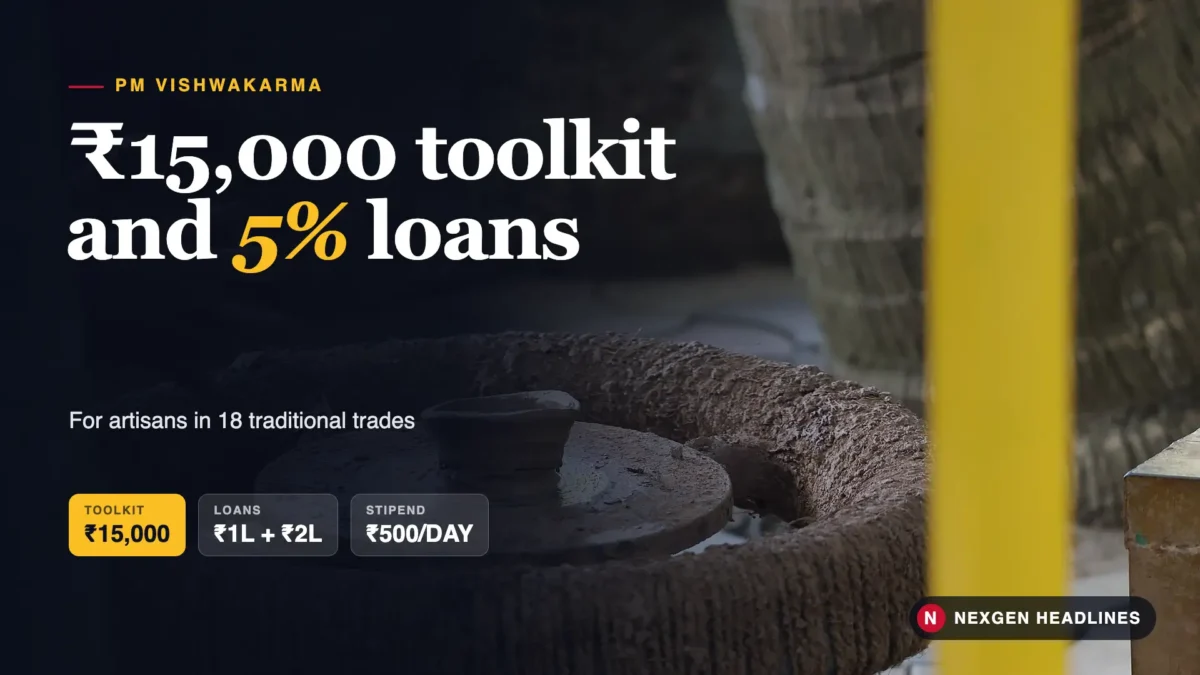
Quick answer: PM Vishwakarma gives traditional artisans in 18 trades a certificate and ID card, skill training with a ₹500-a-day stipend, a ₹15,000 toolkit incentive, and collateral-free loans of ₹1 lakh and then ₹2 lakh at 5% interest. You register free at a Common Service Centre (CSC) with Aadhaar, a mobile number and bank details.
At a glance
- Who runs it: Ministry of MSME, with Skill Development and Finance ministries
- Who can apply: self-employed artisans in 18 trades, age 18+
- Recognition: PM Vishwakarma certificate and ID card
- Training: 5–7 days basic, 15 days or more advanced, ₹500 per day stipend
- Toolkit: up to ₹15,000 incentive (e-voucher)
- Loans: ₹1 lakh (first), ₹2 lakh (second), 5% concessional interest, no collateral
- Apply at: pmvishwakarma.gov.in through a CSC
How to apply: step by step
| Step | What happens | What you need |
|---|---|---|
| 1 | Go to your nearest Common Service Centre (CSC) | Aadhaar, mobile linked to Aadhaar, bank details, ration card |
| 2 | CSC registers you on pmvishwakarma.gov.in with Aadhaar e-KYC | Fingerprint or face authentication |
| 3 | Gram Panchayat head or urban local body verifies you | Proof that you work in the trade |
| 4 | District committee checks and recommends | Nothing extra; track status online |
| 5 | State-level committee approves | — |
| 6 | You get your certificate and ID; training and toolkit follow | Attend skill verification and basic training |
| 7 | Apply for the first ₹1 lakh loan through a bank | Complete basic training first |
Registration through a CSC is free. Do not pay agents who promise faster approval.
The 18 trades covered
The scheme is for family-based traditional trades that work with hands and tools. The 18 trades are:
- Carpenter (Suthar)
- Boat maker
- Armourer
- Blacksmith (Lohar)
- Hammer and tool kit maker
- Locksmith
- Goldsmith (Sonar)
- Potter (Kumhar)
- Sculptor and stone carver; stone breaker
- Cobbler (Charmkar) / shoesmith / footwear artisan
- Mason (Rajmistri)
- Basket, mat and broom maker; coir weaver
- Doll and toy maker (traditional)
- Barber (Naai)
- Garland maker (Malakaar)
- Washerman (Dhobi)
- Tailor (Darzi)
- Fishing net maker
Who is eligible?
- You work with your hands and tools in one of the 18 trades, on your own account (self-employed).
- You are at least 18 years old on the date of registration.
- You have not taken a loan under similar credit-based central or state schemes for self-employment, such as PMEGP, PM SVANidhi or Mudra, in the last 5 years. People who fully repaid such loans may still be eligible.
- Only one member per family can register. A family here means husband, wife and unmarried children.
- People in government service and their family members are not eligible.
Benefits in detail
1. Certificate and ID card
Approved artisans get a PM Vishwakarma certificate and a digital ID. This is your official recognition as a Vishwakarma and your entry to all other benefits.
2. Skill training with stipend
After a skill check, you attend basic training of 5–7 days (about 40 hours). You can then opt for advanced training of 15 days or more. You get a stipend of ₹500 per day during training.
3. Toolkit incentive
At the start of basic training, you get a toolkit incentive of up to ₹15,000 as e-vouchers to buy modern tools for your trade.
4. Collateral-free loans at 5%
| Loan | Amount | Repayment period | When you can get it |
|---|---|---|---|
| First tranche | Up to ₹1 lakh | 18 months | After basic training |
| Second tranche | Up to ₹2 lakh | 30 months | After repaying the first loan, using digital payments or taking advanced training |
You pay a concessional 5% interest. The government pays an interest subvention to the bank and covers the credit guarantee fee, so you do not need to give security.
5. Digital payment incentive
For each digital business transaction, you get ₹1, for up to 100 transactions a month. That is up to ₹100 a month for using UPI or QR payments in your work.
6. Marketing support
The scheme helps with quality certification, branding, listing on e-commerce platforms such as GeM, and trade fairs.
Example (made-up, for illustration)
Ramesh is a 34-year-old carpenter in a village near Nashik. He registers at the local CSC with his Aadhaar and bank passbook. His sarpanch confirms he works as a carpenter. After approval, he attends 6 days of basic training and earns a ₹3,000 stipend at ₹500 a day.
He uses the ₹15,000 toolkit e-voucher to buy a power planer and drill. Then he takes the first ₹1 lakh loan at 5% to buy wood in bulk for a furniture order. He accepts UPI payments from customers and gets ₹1 for each one. After repaying in 18 months, he applies for the ₹2 lakh second loan.
Also read: Jan Dhan account: free bank account and benefits
How to check your application status
- Go to pmvishwakarma.gov.in.
- Click Login and choose the beneficiary login.
- Enter your registered mobile number and OTP.
- See the stage: Gram Panchayat, district or state verification, or approved.
If your application is stuck at one stage for long, contact the CSC that registered you or the District Industries Centre (DIC).
Common mistakes that delay approval
- Wrong trade selected. Pick the trade you really work in. The panchayat checks it.
- Mobile not linked to Aadhaar. Update it first at an Aadhaar centre.
- Two family members applying. Only one per family is allowed; the second will be rejected.
- Recent Mudra or PMEGP loan. An open loan under similar schemes in the last 5 years can make you ineligible.
- Paying middlemen. CSC registration is free. Report anyone who asks for money.
Documents checklist
| Document | Why it is needed |
|---|---|
| Aadhaar card | e-KYC at the CSC |
| Mobile number linked to Aadhaar | OTP for registration and login |
| Bank account details (passbook) | Stipend, toolkit and loan payments |
| Ration card | To check family details (one member per family) |
| Caste certificate (if asked) | Some trades or states may ask for it |
| Photo | For the ID card |
If you do not have a ration card, the CSC operator can tell you which other family documents your state accepts.
Repayment: what the EMI may look like
The loan is cheap, but it is still a loan. Here is a rough idea of repayment at 5% interest, assuming equal monthly payments. These are estimates; your bank will give the exact EMI.
| Loan | Period | Approx. EMI | Approx. total interest |
|---|---|---|---|
| ₹1 lakh | 18 months | about ₹5,770 | about ₹3,900 |
| ₹2 lakh | 30 months | about ₹7,100 | about ₹13,000 |
Calculated estimates, not bank quotes. Some banks may add a moratorium of up to 6 months before EMIs start.
Paying EMIs on time builds your credit score. That helps you get a Mudra or other business loan later, when your work grows.
What the scheme does not do
- It does not give the ₹3 lakh as a grant. Only the toolkit incentive, stipend and digital incentive are not repaid.
- It does not cover all small businesses. Shopkeepers or traders outside the 18 trades should look at Mudra instead.
- It does not guarantee orders. Use the marketing support and e-commerce listing to find buyers.
Where to get help
If you have questions or your application is stuck, you can get help in several places:
- The Common Service Centre that registered you can check your status and fix errors.
- The District Industries Centre (DIC) handles district-level verification and complaints.
- The official portal pmvishwakarma.gov.in has a helpdesk and grievance section.
- Your Gram Panchayat office can tell you if the first-stage verification is done.
Keep your registration number safe. You will need it at every step, from training to the loan application at the bank.
FAQ
How much money do you get under PM Vishwakarma?
A toolkit incentive of up to ₹15,000, a ₹500-a-day training stipend, and loans of ₹1 lakh and ₹2 lakh at 5% interest. The loans must be repaid.
Is the ₹15,000 given in cash?
It is given as e-vouchers to buy tools for your trade, not as free cash for any use.
Can women apply?
Yes. Any eligible artisan aged 18 or above can apply, but only one member per family.
Where do I apply online?
Registration is done through a Common Service Centre on pmvishwakarma.gov.in, using Aadhaar-based e-KYC.
Is a guarantor needed for the loan?
No. The loans are collateral-free; the government covers the credit guarantee fee.
One more tip: keep proof of your work, such as photos of your products, customer receipts or a letter from a local trade body. It makes verification at the panchayat and district level smoother. After approval, use the advanced training as well, because new skills and better tools can help you charge more for your work.
Bottom line
If you are a carpenter, tailor, potter, barber or another of the 18 listed trades, PM Vishwakarma offers real help: ₹15,000 for tools, paid training and up to ₹3 lakh in cheap loans. Register free at a CSC, get verified, finish basic training, and then apply for the first ₹1 lakh loan.
Last reviewed: 9 November 2026. Scheme details as per the PM Vishwakarma guidelines; check pmvishwakarma.gov.in for the latest rules.
Sources: PM Vishwakarma official portal, National Portal of India, Ministry of MSME, Drishti IAS.
Featured image credit: Potter at a traditional wheel in India. Photo: Gannu03 / Wikimedia Commons, CC BY-SA 4.0; edited by Nexgen India